

This post is also available in:
 Português
Few markets have sparked more debate over the years than silver. From retail investors to hardcore “silver bugs,” accusations of price suppression and manipulation by major financial institutions have circulated for decades.
Then came the WallStreetBets era, and Silver became a topic of interest.
After the explosive moves in GameStop, Dogecoin, and several heavily shorted assets, attention quickly turned toward silver markets and the role institutions like JPMorgan Chase & Co. allegedly play within them. Suddenly, a topic once mostly discussed in niche commodity circles exploded into mainstream financial conversation.
Now let’s be clear. Some of the claims surrounding silver manipulation are highly debated, emotional, and at times speculative. However, documented spoofing investigations and settlements involving major banks further fueled distrust of the precious metals market.
Whether you believe silver has been systematically suppressed or simply heavily influenced by futures markets and institutional liquidity, one thing is undeniable: silver remains one of the most emotionally charged and controversial assets in global finance.
And honestly? Looking at the numbers, the volatility, and the repeated regulatory investigations over the years, it is not hard to understand why so many investors remain skeptical of the system.
While much of the debate around silver manipulation gained mainstream attention during the WallStreetBets era, the discussion remains relevant today. In 2026, investors continue to watch silver closely due to growing industrial demand from solar panels, electronics manufacturing, and renewable energy projects. At the same time, concerns about inflation, government debt, and monetary policy have kept precious metals firmly on the radar of long-term investors.
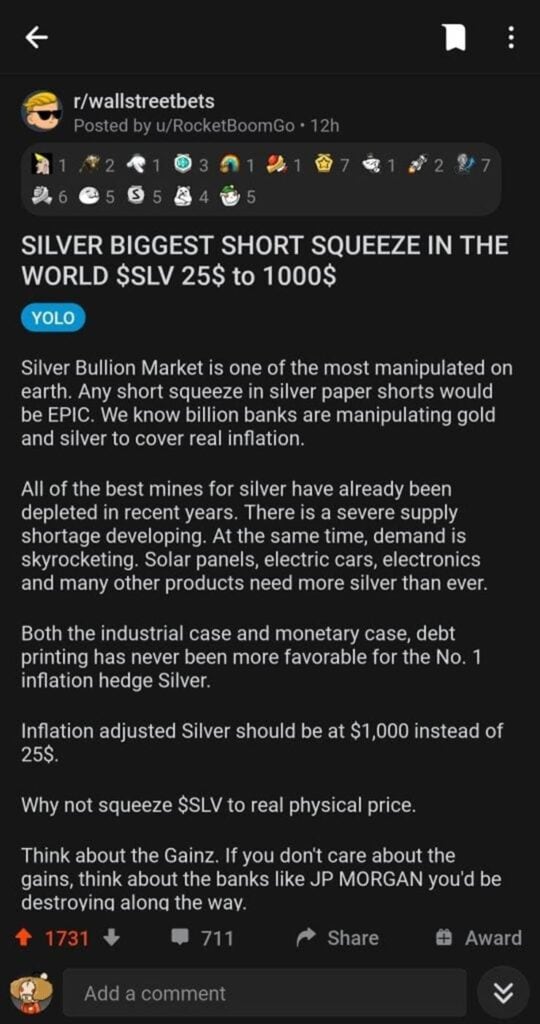
Here comes the SILVER BUGS & WSB Short Squeeze attack on JP Morgan and other institutions. Anger over the elites screwing over retail traders in big institutions has hit a tipping point. With recent trades on Gamestop/Dogecoin and now Silver!? The Reddit crew has much to say!
Regulatory Investigations Added Fuel to the Debate
For years, claims of silver and precious metals manipulation were often dismissed as conspiracy theories within mainstream finance. However, regulatory investigations into spoofing practices later significantly changed the conversation.
In 2020, JPMorgan Chase & Co. agreed to pay hundreds of millions of dollars to resolve investigations tied to precious metals and Treasury market spoofing. Several traders were also charged with manipulative trading practices in futures markets.
While these cases did not validate every broader theory surrounding long-term silver suppression, they undeniably reinforced concerns that parts of the precious metals market had been vulnerable to manipulation and abusive trading behavior.
For many retail investors, especially after the 2008 financial crisis and the COVID-19-era monetary expansion, trust in major institutions was already deteriorating. The silver debate simply became another battleground in a much larger discussion around markets, inflation, central banking, and financial power.
Why Silver Market Manipulation Concerns Continue Today
It also prompted governments and financial authorities to review several policies, and investors to move to secure their holdings. As JP Morgan was able to gobble up all their competitors in the wake of the 2008-09 financial crisis, which they helped cause, this entity, like
Amazon has become too big to fail, and many should start to watch out for the “Monopoly Effect” this will have on our economies in the near future.
With the COVID-19 crisis, there has been a surge in the precious metals market and renewed interest in mid- and long-term trading in safe-haven assets like gold and silver. However, critics of the precious metals market argue that large institutional players and futures market dynamics continue to have an outsized influence on price discovery, contributing to ongoing distrust among many retail investors.
While the claims had not been substantiated, the recent spoofing probe of the global bank JP Morgan had drawn many’s attention to the possible manipulation of the market. This had also reinforced the idea that they might have been buying into a bubble.
In this article, we expound on the silver market and the resulting effects of price manipulation in the market landscape.
Silver Trade: The Journey So Far
Silver is admittedly the oldest form of mass-produced coinage and collectible, apart from gold. It was widely recognized as a store of value and designated as legal tender until its discontinuation.
However, the growth of silver in the market is fuelled by the simple laws of supply and demand. It has been in high demand for applications in jewelry and other industrial purposes. It has an independence that makes it suitable as an alternative investment option and a hedge against tail risks.
The value of Silver has grown exponentially over the last few decades and has weathered periods of uncertainty, remaining relevant. Unlike gold, silver’s price is more volatile and susceptible to market manipulation, especially amid high economic risk.
Despite the uncertainty that swept through financial markets due to the coronavirus pandemic, silver has held its own in the U.S. stock market.
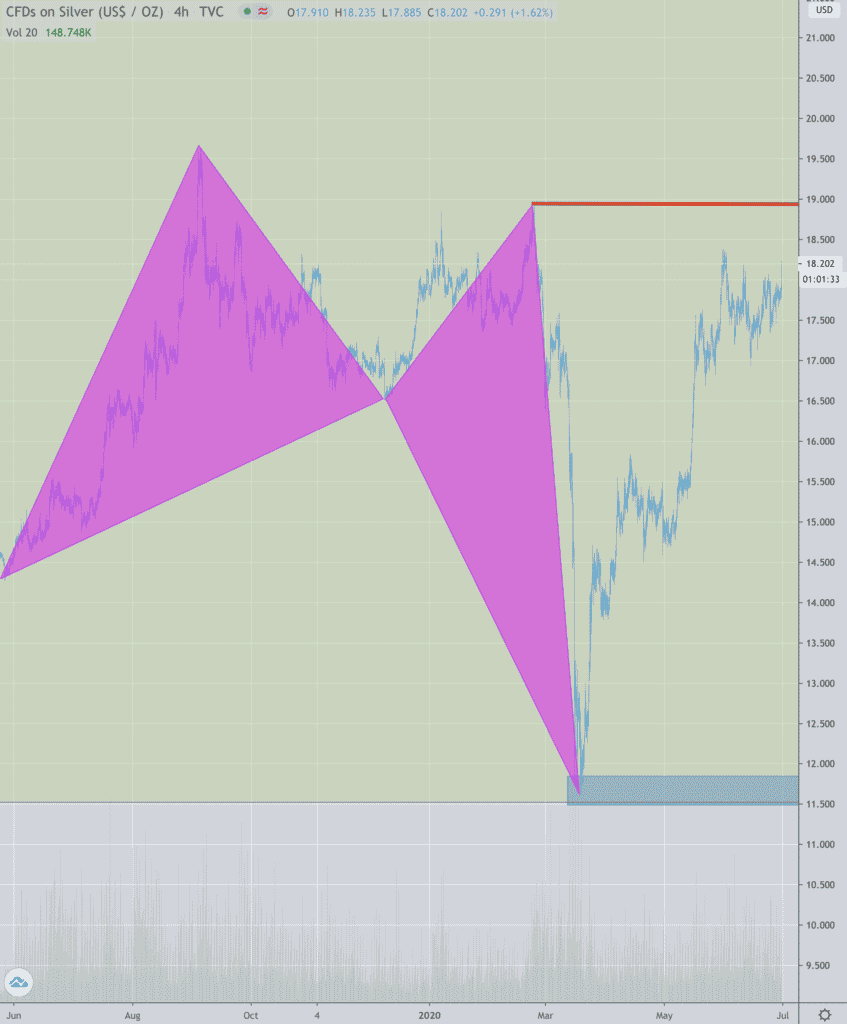
The market experienced one of its worst stock sell-offs in mid-March, resulting in declines in the prices of several assets and indices. S & P 500 fell 27% YTD, and May futures had dropped to about $12.34 per ounce of Silver.
The market had been projected to recover by 13% from its two-year marginal losses. True to form, the metal had risen to $18.60 before crashing below the $12 mark. Though the price had stabilized in the $15 range, it still fell 13% at the beginning of the year.
Silver’s Susceptibility to Suppression and Price Slides
Though like every metal and asset, silver is driven by market sentiment, it is an independent metal. This is so because its value is not tethered to any currency, and, like gold, its price is not subject to the control of the U.S. government or the Federal Reserve System.
Its market is global, with demand driving price movements. The metal has a dual nature, serving as both a monetary asset and a commodity. While its nature suggests it is a safe-haven asset, silver appears not to have benefited from this due to its high industrial correlation.
Unlike gold, silver’s demand is driven by industrial uses. Towards the end of the first quarter of 2020, most industrial operations had slowed due to the global pandemic.
Though questions had been raised about the impact of the operational slowdown on the physical supply of the metal, more arguments and market sentiment had focused on industrial demand.
Reports indicate that nearly 60% of the total supply of silver is used industrially. This highlights that the dwindling physical and industrial demand for silver is a primary driver of the price decline, further underscoring silver’s price sensitivity to demand and supply.
What Drives the Price of Silver?
It is worth noting that Silver’s place as a hedge or insurance against economic downturns makes it an excellent investment choice for portfolio diversification. This, though, means that, like gold, the price of silver is also influenced by real interest rates, the U.S. Dollar Index, and market sentiment or fear levels.
Despite being a millennial metal, silver has a smaller market cap than gold and, as such, lower liquidity. This makes the silver market a tad more volatile and more susceptible to market manipulations.
Also, the futures market is admittedly one of the most dominant forces in determining prices and trading this metal. Price suppression is also subject to market makers like Goldman Sachs and JPMorgan.
However, due to the nature of the metal, this suppression is easily reversed.
How is the Silver Price Manipulated?
The discrepancies between current and projected prices mostly suggest manipulation. Silver prices are primarily driven by market dynamics, with futures market participants and commodity exchanges playing key roles.
The manipulation occurs due to any of the following mechanisms or a combination:
- The placement of shorts in the futures market, or naked shorts
- Spoofing is the placement and cancellation of fake orders.
- Rehypothecation- This entails placing the same ounce of silver as collateral for multiple loans and agreements.
- Tweaking and rigging of rules on commodity exchanges such as the LBMA and COMEX: This usually entails settling futures contracts in cash rather than in the actual physical silver.
- Manipulative funding: This entails injecting false liquidity into the market by leveraging dark pools of capital to fund trades.
JP Morgan’s Alleged Price Manipulation
For years, the global financial markets have been awash with allegations of price manipulation in precious metals such as silver and gold, with no legitimate evidence to back them up. However, the recent probe into the financial institution JPMorgan expanded on these claims.
Six JPMorgan Chase & Co. employees were accused of manipulating precious metals futures by the U.S. authorities. The bank was suspected of spoofing thousands of gold and silver futures orders for its benefit and that of its premium hedge fund clients.
The accusation levied against the bank led to a two-year probe by the US Justice Department and the Commodity Futures Trading Commission (CFTC). The manipulation campaign involved placing orders on futures contracts and then canceling them to mislead several market participants.
As mentioned above, one of the most critical aspects of the silver market is the Futures market, as well as the role of market makers. This aspect of the silver trade exploits the metal’s supply and demand to manipulate the price as they deem fit.
The bank came under the radar of U.S. authorities after an ex-trader at the bank’s precious metals desk confessed to a six-year spoofing scheme. The trader had stated that the price manipulation had taken place between 2009 and 2014 with the knowledge of superiors at the metal desk.
The JPMorgan Spoofing Investigation
JPMorgan’s alleged price manipulation involved traders placing numerous orders for silver futures with no intention of following through on the contracts or executing the orders.
The plan is to inject false liquidity into the market and create a bubble to benefit their market position. With this, market participants without adequate fundamental knowledge of the silver market’s movers buy into this bubble and, in most cases, get stuck with limited exit options.
While JPMorgan has long been at the center of market-manipulation allegations, several others were not left out. In 2015, about 10 banks were also accused and brought to the attention of U.S. financial authorities for manipulating metals and commodities.
HSBC Holdings, the Bank of Scotia, and the UBS Group were reportedly involved in silver rate manipulation between 2007 and 2013.
Should You Invest in Silver?
Despite silver’s susceptibility to manipulation, it appears to be the best fit for investors looking to hedge against market uncertainties, especially now amid the COVID-19 pandemic and the unknown effects further out.
Though there are significant concerns that the suspension of mining and industrial activities could impede silver supply, experts believe inventories will accommodate global demand.
Despite metal prices and market upheavals, analysts believe buying silver is quite promising. Beliefs in the silver market suggest that price manipulation will soon be curtailed and the market will see a positive shift.
However, while investing in silver can be lucrative given its role as a safe-haven asset, it is essential to understand the fundamentals of market movements and price determinants.
Signs are all over, as we wrote about the likelihood that Warren Buffett will buy gold. A giant wave of inflation, with the dollar printing machines going off the rails. We have printed nearly a quarter of all dollars in existence in 2020 alone! Scary stuff indeed…
JP Morgan views the U.S. government as a leech & cost of doing business.
This firm knows that the benefits of its criminal actions, like those of most banks that continue to break the law, are a cost of doing business. With Trump’s tax cuts alone, which benefit banks and allow them to easily absorb these fines as just minor business costs, even more than a few have been heard calling the government leeches who are not worth their time.
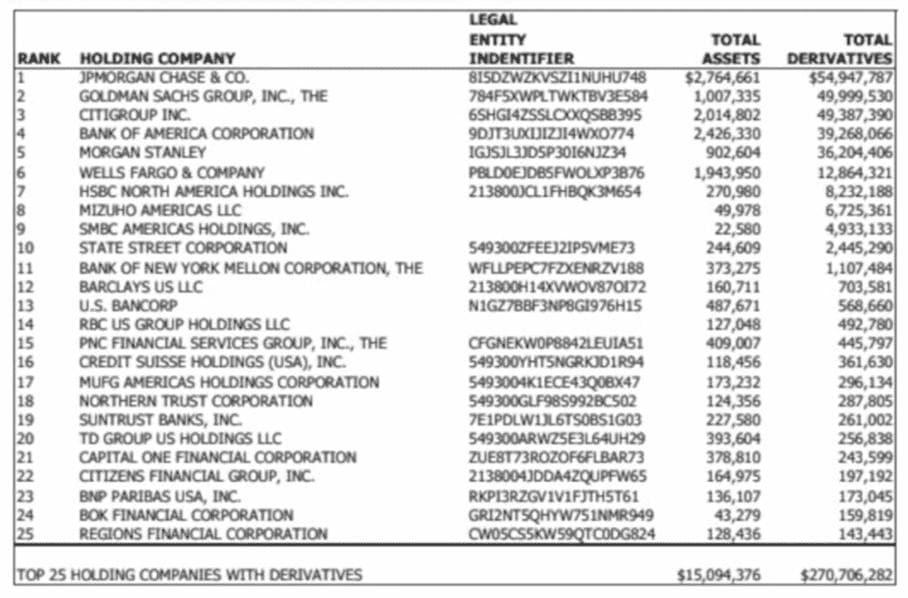
Macro price manipulation is a team sport being played by banks
The banks are working together as seen by the charts/statistics, the trades of JP Morgan you can think of as the team captain in this fraud laden activity they pursue and who is the victim of their activity, well their own clients, retail investors even the governments of the world, they set the prices they trigger the algos, they simply control the market and no matter how many fines they pay if they make many time more off these transactions, well they will keep doing them. It will not be until the leadership of these banks faces real criminal charges that they will ever change their behavior.
“One ironic note is how, during their hoarding of Silver and Gold, they had a policy of banning their own customers from storing silver and gold in safety deposit boxes and even requested customers to sell their holdings.” JP Morgan was all too willing to buy, or should we say snatch, the holdings of their own clients, disgusting behavior, this is how a bank is supposed to act now for the benefit of its customers! I think not…
What allowed JPMorgan to corner the silver market?
Back in the 90s, when hedge funds and trading houses such as Merrill Lynch, Goldman Sachs, and others in the industry were earning huge fees/incomes, the bankers became very, very jealous and wanted in on the action. This is where the “Monopoly Effect,” which I will talk about in future articles, and the negative impacts it has on our society as a whole, will come into play. Clinton started the ball rolling by allowing the repeal of the “Glass-Steagall Act,” and then, coupled with the Bush deregulation and tax cuts, the public was sitting ducks for the bankers’ evil plans.
Market Concentration and Silver Ownership
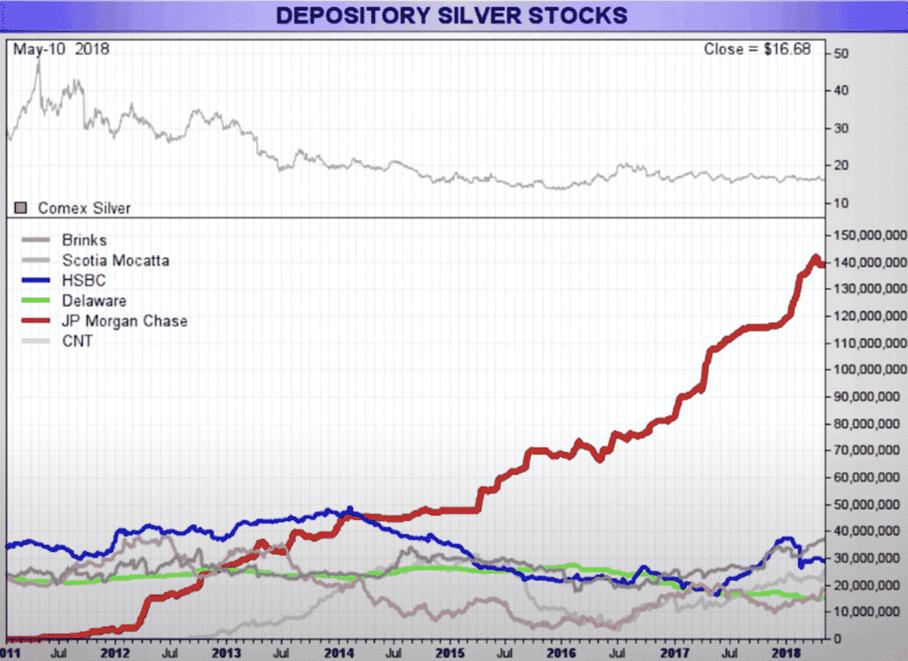
This is how JPMorgan was able to buy up and take over its previous competitors, along with all their assets, including their silver holdings, giving it the power to corner the market.
‘JP Morgan now holds 133.1 million ounces of physical silver and the world record for most silver held under one name. Today, it also owns 50% of the world’s COMEX silver bullion. Jun 4, 2019.”
The average person rarely considers how deeply financial policy, inflation, and market concentration can affect long-term purchasing power and wealth inequality. Critics of the modern financial system argue that excessive consolidation within banking and finance has contributed to widening economic gaps across Western economies.
Bankers control vast sums of wealth not only in the United States but in the Western world as well; we have the highest ever wealth inequality recorded, and the negative effects are starting to bubble up with protesters and the echoes as the people realize just how screwed they are.
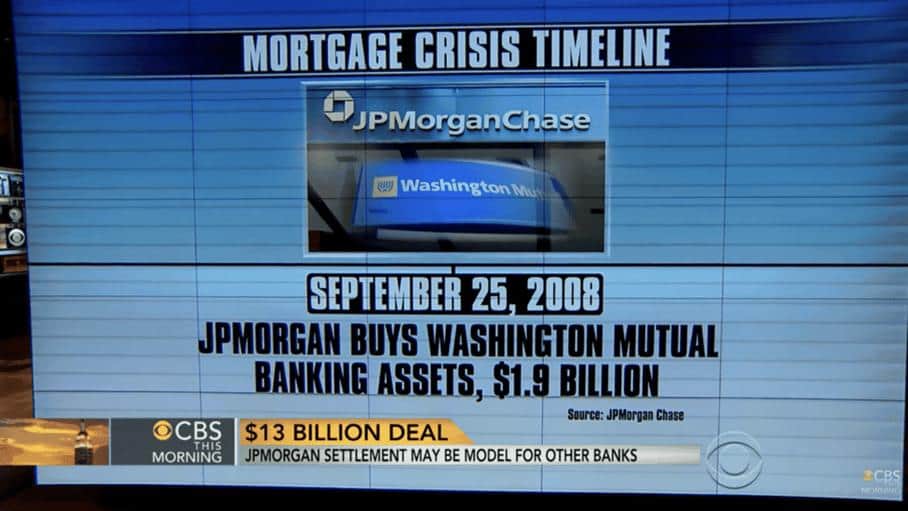
This is systematic. Do you really think that the 2008-09 financial crisis was just a one-off? Do you think the grand wealth transfer which cost many their homes/retirement savings, and the like, was not systematically transferred to an ever smaller organized group of individuals hiding in the shadows and filling the lobbies of Washington ever more in total control of the money spigot in this disgusting destruction of our society, Silver/Gold and other asset classes are just part of the big picture here.
The manipulation they enjoy today of where they set the prices in this cornered market will have a reckoning, as normal everyday people simply won’t be able to afford much because the banks own your gold, silver, home, money, and pretty much your lives. The silver market is just the most obvious way JP Morgan and friends show us how the banking sector, after the repeal of Glass-Steagall and Bush-era deregulation, opened a Pandora’s box of bad actors who stole wealth from the average American, with untold effects on economies abroad.
Here is what you will find from Koch and friends, the Cato Institute
Koch brothers and many like them now control Washington with an iron fist even try to spin and rewrite history with their funding of the Cato institute that has this lovely manipulation of history trying to downplay the effects of the “Glass Steagall Act” and Bush deregulation which the Koch family and others were able to feed their wealth all while their systematic racism in Flint echoed on harming mainly black families with contaminated water in Michigan.
These are the friends and partners of JP Morgan and Gang; these are the overseers of our society who destroy lives without retribution or penalty. Silver is just a glaring example of what they have been able to do with the government’s help to harm our society and the average American citizen. Jamie Dimon thinks of himself as a patriot, ha! You and your kind are just parasites that lower the quality of life for the average American you feed off of in your parasitic feast.
Cato is trying to hide the fact that the Glass-Steagall Act protects our society from what exactly happened that allowed for the ever-widening wealth inequality in our society and enabled JP Morgan to corner the silver market, as they continue
JP Morgan gives us all the middle finger as they buy Silver.
Do you really think JP Morgan did not benefit on the price collapse/exaggeration which imo I bet if anybody in the government with oversight would investigate could easily find in JP Morgan’s trading of Silver how they were responsible for much of the exaggeration/effect of the above chart on the fall of silver to the $11 range and how they are now looking to profit off the long side in a GIANT COIL of which they will benefit, too big to fail after all!
See how these two articles tie in; don’t be surprised if SILVER HAS A MASSIVE up move in the future, after all Jamie Dimon and friends need to get paid 🙂
Bitcoin Risks Breaking $9k as JP Morgan warns of stock selloff
So they are short the stock market that fools like the FED/Trump are trying to push up, knowing the coming effect of their disastrous economic policies, as well as the very long metals market. Again, this is mostly my personal rant, but the problem is the numbers don’t lie, even if people do, and the numbers I show in the above happen to be very, very true.
In conclusion…
The offset of the coming inflation can be seen across many macro charts and market trends. Whether people want to admit it or not, large institutions and smart money tend to position themselves well ahead of the broader public as major economic shifts unfold.
Given silver’s inflationary pressures, debt expansion, and continued monetary intervention, it is not difficult to understand why many long-term investors remain bullish on precious metals. If silver eventually breaks into a much larger move higher, many will likely look back at this period very differently.
Much of this article reflects the writer’s personal opinion and macro-level interpretation. However, repeated regulatory investigations, spoofing cases, and growing distrust in traditional financial systems have only added fuel to the broader debate over silver and institutional market influence.
