

Gold and Silver have become one of the most volatile financial markets in recent years. Inflation concerns, central bank policies, geopolitical tensions, and economic uncertainty can cause the precious metals to move millions of dollars within days. While these strong trends create trading opportunities, they also expose the weaknesses of many automated trading systems.
As a result, more traders are looking for a non-Martingale gold trading Bot that prioritizes disciplined risk management over aggressive recovery strategies. Instead of increasing exposure after losing trades, these Expert Advisors focus on predefined risk and structured execution.
But does that automatically make them safer? In this guide, we explain the differences between grid, Martingale, and non-Martingale systems, discuss their advantages and limitations, and explain what you should evaluate before trusting any automated trading software.
Why Gold Is One of the Most Challenging Markets for Automated Trading
Gold behaves differently from many other financial instruments. While currency pairs often spend significant time moving sideways, gold regularly experiences strong trends driven by macroeconomic events. Examples include:
- Interest rate decisions by the Federal Reserve
- Inflation data releases
- Banking crises
- Military conflicts
- Central bank gold purchases
- US Dollar strength or weakness
These events can produce sustained directional moves that last for days or even weeks. For automated trading systems, this creates a difficult environment because strategies designed for ranging markets may struggle when trends continue much longer than expected. That is one reason many traders now prefer a non-Martingale gold trading bot that defines risk before each trade rather than relying on price reversals.
Grid vs Martingale vs Non-Martingale Gold Trading Bot
Not every trading bot manages risk in the same way. Understanding how these approaches differ is essential before choosing an Expert Advisor.
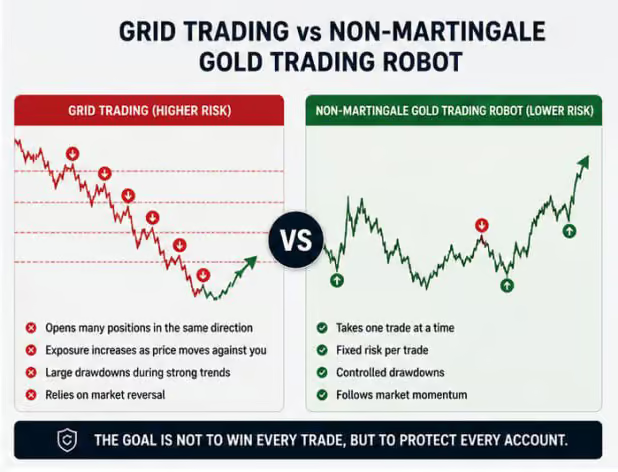
| Strategy | How It Works | Risk Level | Drawdown | Suitable For |
|---|---|---|---|---|
| Grid Trading | Opens multiple positions at predefined price intervals | High | High | Experienced traders |
| Martingale | Doubles position size after losses | Very High | Extreme | Not recommended for most traders |
| Non-Martingale Gold Trading bot | Every trade has independent risk and fixed position sizing | Moderate | Generally Lower | Most traders |
Grid systems assume that price will eventually reverse. During ranging markets this can work well, but prolonged trends often create increasing floating losses.
Martingale systems go one step further by increasing trade size after every loss. While this can recover losses quickly during favorable market conditions, it also increases risk exponentially if the market continues moving against the position.
A non-Martingale gold trading bot follows a different philosophy. Each trade is treated independently, meaning previous losses do not influence the size of the next position.
Why Position Sizing Matters More Than Recovery
One of the biggest misconceptions in automated trading is that recovering losses quickly is always beneficial. Consider a Martingale strategy that begins with a single lot. After the first losing trade, the position size doubles to two lots. A second loss increases exposure to four lots, followed by eight, sixteen, and eventually thirty-two lots after six consecutive losing trades.
Although several losses in a row may seem unlikely, periods of extreme market volatility can create exactly those conditions. Because exposure increases exponentially, even a relatively small losing streak can place enormous pressure on trading capital.
A non-Martingale gold trading bot avoids this problem by keeping position sizes consistent or by adjusting them only according to predefined account risk. Since every trade is treated independently, previous losses do not automatically increase exposure. Recovery may take longer, but overall account risk remains far more predictable.
Why Many Gold Traders Prefer the H4 Timeframe
Many modern Expert Advisors are designed around the four-hour chart instead of lower timeframes. There are several reasons for this. First, lower timeframes such as one-minute and five-minute charts contain significantly more market noise. Short-term price spikes can trigger false entries that have little relation to the broader market direction.
Second, trading less frequently reduces the impact of spreads, commissions, and slippage. Finally, the H4 timeframe allows algorithms to focus on larger market trends rather than reacting to every minor fluctuation.
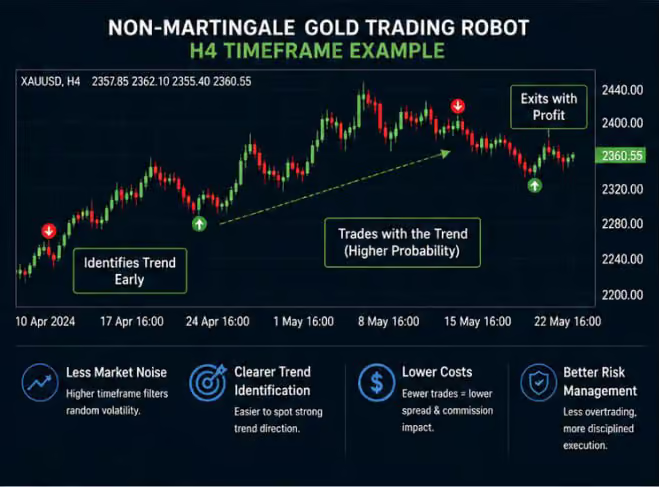
That does not mean H4 is always superior. Scalping systems can perform well under certain market conditions. However, trend-following strategies often benefit from the additional confirmation that higher timeframes provide.
What Makes a Reliable Non-Martingale Gold Trading Bot?
Marketing pages often focus on impressive profit percentages, but those numbers rarely tell the full story. When evaluating a non-Martingale gold trading bot, consider the following factors instead:
- Verified Live Performance: Backtests can be useful, but verified live accounts provide much stronger evidence of long-term consistency.
- Maximum Drawdown: Profit means little if an account experiences drawdowns of 60% or more. Lower and consistent drawdowns are generally a stronger indicator of sustainable risk management.
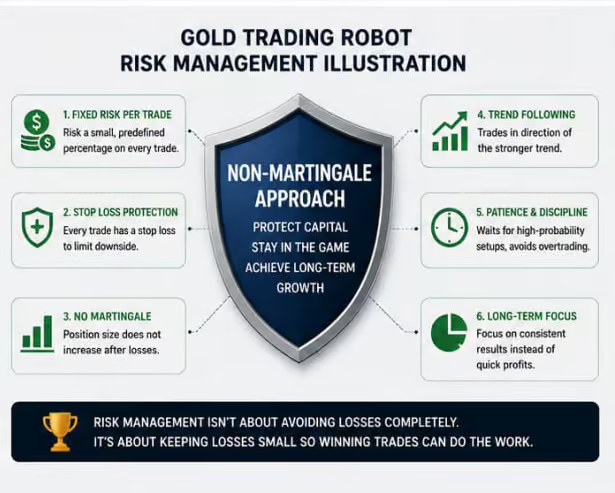
- Fixed Risk Per Trade: Reliable systems define maximum risk before entering a position rather than increasing exposure after losses.
- Transparent Trading Logic: While developers may not disclose every detail of their strategy, they should clearly explain their overall approach, supported markets, recommended brokers, and expected trading frequency.
- Realistic Expectations: No automated trading system wins every trade. Be cautious of products advertising guaranteed profits or unrealistically high win rates without independent verification.
Advantages of a Non-Martingale Gold Trading Bot
There are several reasons why disciplined risk management has become increasingly popular.
- Every trade has predefined risk.
- Position sizes remain consistent.
- Drawdowns are generally easier to manage.
- Strong market trends are less likely to create catastrophic losses.
- Capital preservation becomes the primary objective.
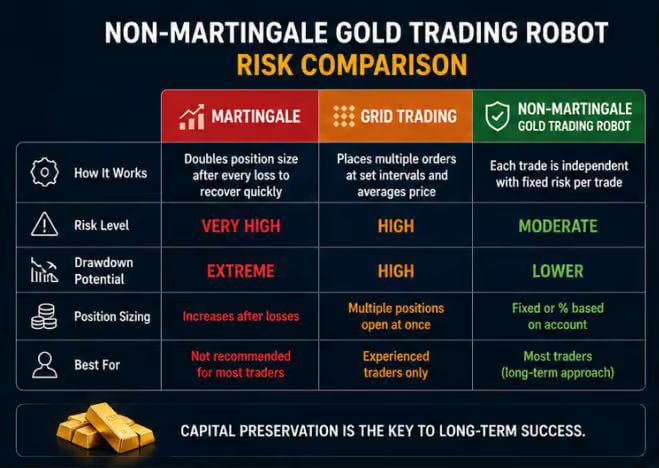
For long-term traders, preserving trading capital is often more important than maximizing returns during short periods.
Potential Limitations
A non-Martingale gold trading bot is not perfect. Compared with aggressive recovery systems, traders may experience:
- Slower account growth during ranging markets.
- Longer recovery after losing streaks.
- Fewer trading opportunities.
- Lower overall win rates in exchange for better risk control.
These trade-offs are often acceptable for traders who prioritize consistency over rapid account growth.
What to Consider Before Choosing a Gold Trading Bot
If you’re researching Fexobot, it’s worth comparing feedback from several independent review platforms before making a purchase decision. One example is its ProvenExpert review profile on Fexobot. User reviews can provide useful insights, but they should never replace verified live performance statistics or your own testing.
From a risk management perspective, the philosophy of predefined stop-losses, fixed position sizing, and independent trade execution aligns with many of the principles discussed throughout this article.
However, SmartOptions has not independently verified the long-term live performance of Fexobot. As with any Expert Advisor, we recommend reviewing verified trading records, understanding the strategy, and testing the software on a demo account before risking real capital.
Learn More About Intelligent Forex Bots
If you’re interested in automated trading beyond gold, we also recommend reading our guide on intelligent Forex bots. It explains how modern Expert Advisors use technical indicators, machine learning, and structured risk management to improve consistency across different market conditions.
Final Thoughts
Choosing a non-Martingale gold trading bot is not about finding a system that never loses. It is about selecting an approach that manages risk responsibly while giving traders the opportunity to participate in long-term market trends.
Whether you are evaluating Fexobot or another Expert Advisor, focus less on headline profit claims and more on verified performance, realistic drawdowns, transparent risk management, and consistent execution. Those factors are far more important than any marketing promise and are usually what separates sustainable automated trading systems from those that eventually fail.
Frequently Asked Questions
Generally, yes. Because every trade has predefined risk and position sizes do not increase after losses, the probability of catastrophic drawdowns is typically lower than with Martingale strategies. However, no trading system is completely risk-free.
No. Every automated trading strategy experiences losing trades. Any product promising guaranteed returns should be treated with caution.
The H4 timeframe often filters out short-term market noise and may be well suited for trend-following systems. Whether it performs better depends on the strategy and market conditions.
Beginners should first understand how the strategy manages risk before using any automated software. Starting with a demo account and conservative position sizing is generally recommended.
