

This post is also available in:
 Português
Maybe you have already read about buying and selling walls, and the topic is everywhere if you lurk in the Crypto world. Buy and sell walls represent traders' current sentiment by visualizing all buy and sell orders in the order book. The walls are your outlook into the future, but you have to take this with a big grain of salt. Buy and sell walls are useful for short-term trading and for estimating whether a coin reaches a level or identifying a better entry point. All in all, if you are going to hodl, these walls are almost useless; they can be used to tweak your profits a bit concerning a better entry price. Many professional traders combine order book analysis with high-quality Telegram crypto signals to improve entries and exits. But let's do some groundwork and start from the beginning by diving into this exciting topic.
Table of Contents (click to expand)
The Order Book
What exactly is an order book? It’s a list of all active buy/sell orders placed for a particular coin on an exchange like Binance. Order books are an excellent source for determining trader sentiment for a given coin. It lets traders view a list of buy & sell orders and provides a sense of market depth.
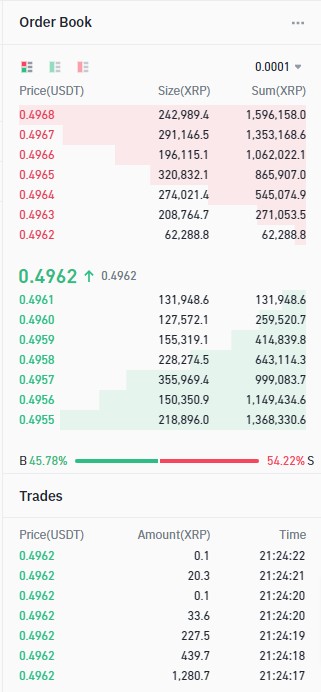
BIDS are offers to buy a coin at a certain price, while ASKS are offers to sell a coin at a particular price. The order book allows traders to see the highest bids and lowest asks currently placed on the exchange. On most of the best crypto exchanges, you can also buy or sell directly through the order book itself. In general, green walls represent buying pressure and support levels, while red walls indicate selling pressure and resistance. Keep in mind that order book trading is mainly useful for short-term trading opportunities and smaller market moves. Many traders combine order book analysis with technical analysis to identify quick momentum shifts, short-term breakouts, and changes in overall market sentiment throughout the day.
What is a Buy Wall?
A buy wall occurs when the volume of buy orders for a particular coin is much higher than the volume of sell orders. The wider/taller a buy wall is, the better it is. It’s a good sign when traders see a buy wall, as it indicates a reasonable belief in the coin's current state. In other words, traders want to purchase more than they want to sell. In that case, traders buy more than they sell, and it’s a race to purchase all the cheap orders. When cheap orders are bought, buy orders fill in quickly behind the rising price.
It’s crucial to short-term/day trade a cryptocurrency that already has a positive sentiment. If you take that approach, you’re doing well on your way to getting better results. On the other hand, if you don’t, you could have problems getting good daily results. That’s the name of the game! So, it’s critical to trade a coin that has a positive sentiment and healthy activity.
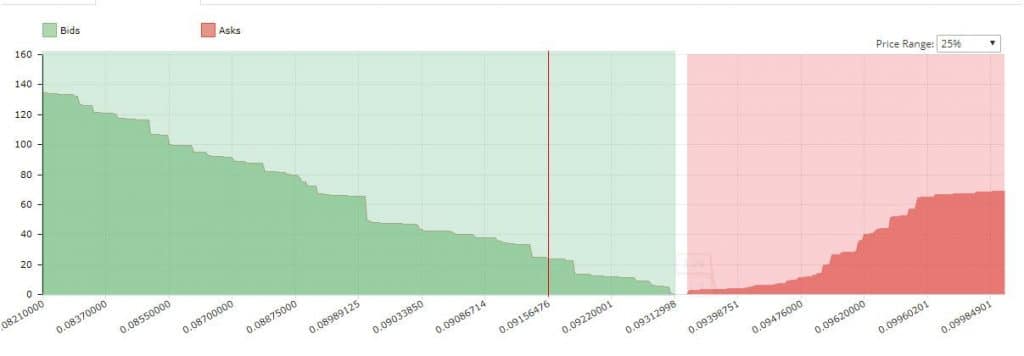
Here is an excellent example of a buy wall, a good one to see the buy orders exceed the sell orders significantly. I marked the middle of the graph with a red line. We like to look at the buy wall going up gradually here, which is a good sign for slow and steady growth. The green candles should not explode but slowly grow more and more.
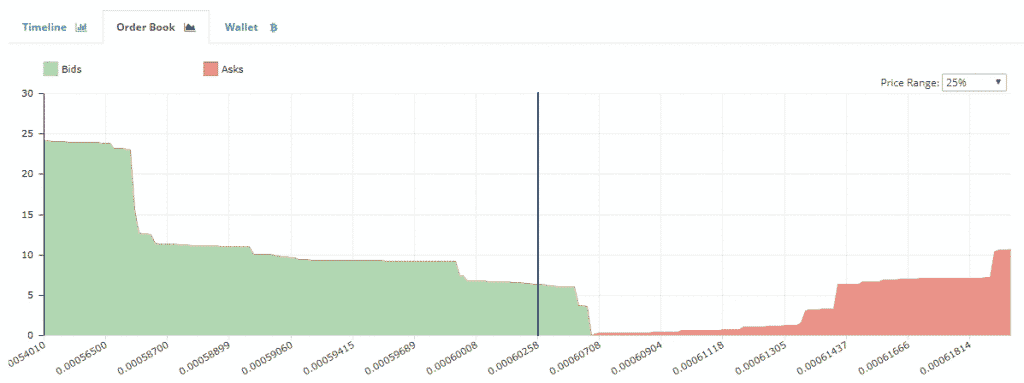
Below is a not-so-cute buy wall. We can see that buy orders still exceed sell orders, so the price is likely to increase, though you have to remember that the big spike in the left area might be fake.
What is a Sell Wall?
I am sure you are smart enough to guess this, but just to be sure: A sell wall is the same as a buy wall, except the sentiment goes in the opposite direction. A sell wall shows some tough times for a cryptocurrency. In this case, the sellers build traders' piles to sell. A big sell-off is underway, and traders usually fill the highest buy order visible on the market.
After the highest buy order gets filled, the order that’s next-lowest in the book becomes filled. This process continues until the market levels out. If you see a big sell wall upcoming, there’s a good chance it’s a bad time to buy that coin and a good time to get out.
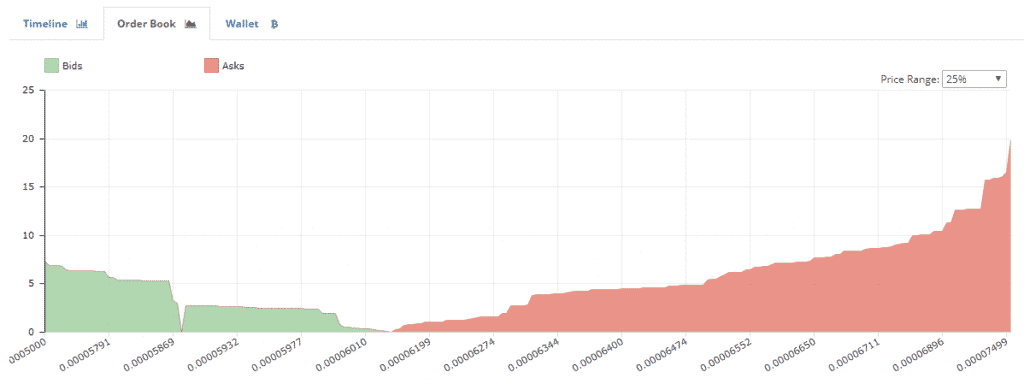
Here is an example of a sell wall. The sell orders exceed the buyers' demand:
The background behind Buy/Sell Walls
You might be wondering if you should even worry about buying/selling walls. In almost every market, buy/sell walls are becoming more popular across exchanges. There are significant buy/sell orders for all popular coins. In general, you should check the right column to see if the coin has a minimum trading volume of 500 Bitcoins to ensure sufficient liquidity and trading activity. Several people purchased the currencies at a rock-bottom price and hoped to cash out as soon as they could.
Whales
Also, whales (big players) effectively control cryptocurrency prices when they can. They don’t benefit when they let any currency break above a particular level until they’re profiting. In many cases, a sell wall is a fake oppression tool that’s used to keep prices far below the maximum. threshold. This allows whales to buy large amounts of cheap coins. We will go over that later on: “How to spot a fake wall”. When people have enough money to manipulate a particular market, someone will likely try to do so. Some professional trading groups, including Binance Killers, frequently incorporate whale activity and liquidity behavior into their market analysis.
While many people believe what they see, the fact is that buy & sell walls aren’t native to any particular trader. When more significant buy & sell orders show up, it’s to be expected that others will put their own orders at that price point. Besides, currency exchanges rarely create buy & sell walls on their own unless they must comply with an existing agreement. In the majority of cases, those agreements are about an ICO in which developers agree to purchase X number of coins at a particular price, but that is a pretty rare exception.
No particular strategy
An important question that always arises is whether there is a specific strategy for keeping prices low, aside from the perspective that involves projections. It appears there is no justification for large buy and sell orders unless someone is attempting to manipulate the market. While there are various popular trading strategies, buy and sell walls do not typically fall into this category.
Liquidity
Meanwhile, sell walls are frequently viewed as a sign of significant liquidity. That’s a plus, since it shows there are plenty of coins available to buy. Meanwhile, without a high enough buy demand, there’s little reason to create active sell orders. That’s because, in such situations, whales would want to dump their coins on the market as well as fill current buy orders. Several buy walls frequently attract large holders seeking liquidity to dump their coins.
Big Walls
Something worth noting about big buy & sell orders is that they often only show up for a short time before being completely removed. It’s also possible that orders are moved up/down based on how the market responds to observing the walls. This kind of action is more apparent since the Mt. Gox manipulation of order books many years ago. It’s clear market makers are still using big walls. However, in many cases, the effects are small. There are times when major players in the cryptocurrency market, such as Roger Ver and Jihan Wu, attempt to make significant disruptive moves. Their goal is to gain a strategic advantage by influencing prices, causing smaller investors to react in a chaotic way. This frenzy creates the liquidity they desire while trapping less experienced traders into making poor decisions at inopportune moments.
What about those Fake Walls?
If you are day trading cryptos with short-term positions, it’s important to play smart. Certain whales can manipulate markets. These are traders with large amounts of capital that can put a buy/sell order at a particular position that’s big enough that it probably won’t be filled. Whales can set the floor/ceiling for future price movement.
What are fake walls?
Fake walls can be observed by appearing tall/vertical. They usually don’t have a price runway and are typically put as either the lowest sell order/highest buy order on a crypto exchange. These are “fake walls” since the trader who placed the order can remove them anytime. He tries to convince other traders to result in a particular price movement. To put it another way, the sentiment itself is fake, and there’s no big market support.
Fake Buy Walls
In the case of a fake buy wall, whales put big/unfillable orders that are highly charged with sentiment for a cryptocurrency. The walls provide new traders some confidence that the particular position will hold, and also lead them to think that the current price points are now the new floor. The result is that buy orders will start showing up on the wall.
It might seem that they can only go up. In fact, whales can remove the wall anytime they want. In that case, the order of the whale makes up most of the orders, so the price can shift far in the other direction. The traders who try to get into the pump may also lose capital (satoshis, the smallest BTC unit) as the whales get out while you get in. Always remember that trading is a zero-sum game, and there is still one person paying for someone else's profits.
Fake Sell Walls
This is also true for fake sell walls. Here’s why Whales can place big and unfillable sell orders to hold down the price and buy the coin on the cheap. After they get enough coins, they can quickly pull their order off, causing the price to spike. In this case, the sentiment was mostly positive, independent of their order, of course. That’s how the whale can win by tricking the traders into selling their coins cheaply.
Pump and Dump
Keep in mind that whales use buy/sell orders to identify pumpable coins for pump-and-dump actions. A pump-and-dump can be profitable for those who know there is a pump early; for everyone else, it is very dangerous eye candy. Whales are searching for low-volume shitcoins with minimal sell orders. Pumpable coins don't need much buy support to increase. So, they are searching for low-volume coins that have very little resistance to active sell orders on the order book. Again, it is hazardous to participate in such games, and likely, you will be paying the whales with your coins at the end of the day.
How does an artificial fake wall look?
The example below is from LTC this morning, a very bullish coin with huge demand. Whales are interested in buying at the best price, so they use their large holdings of BTC to scare traders. They are putting up fake sell walls to push prices down and to purchase the coins more cheaply. They simply remove their sell orders once the price has been pushed down and purchase.
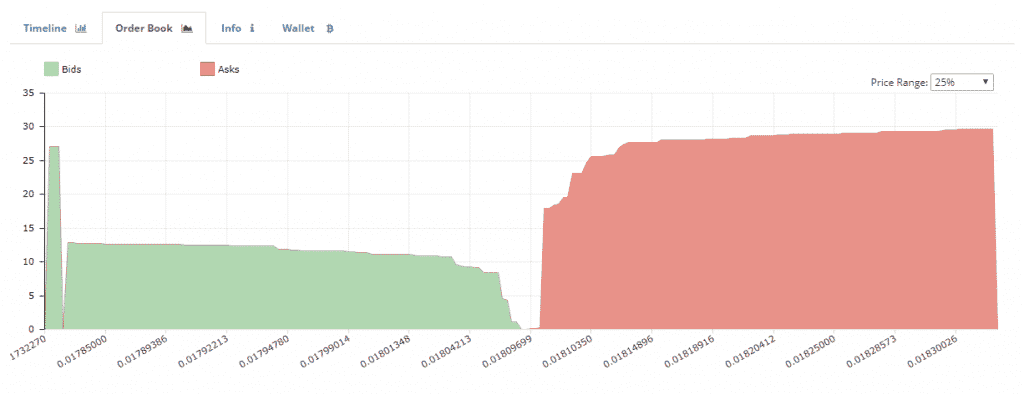
Crypto markets are young, and this kind of manipulation can be easily carried out with enough funds. You can use these fake walls to follow the whales' money and buy the dip. If you already have this coin, don't panic and sell; just buy more on the dip to accumulate. Note these walls are not made by professional whales, as they are easy to spot. Well-versed whales will do a much better job of covering their tracks in order to get your coins on the cheap!
Good luck with fake Sellwalls
So, does this mean traders should buy when a fake sell wall is forming, since the price could spike when the wall is pulled later? A smart thought, but the thought is flawed. In fact, the opposite is true. Traders ought to have a moderate amount of risk, but it’s very dangerous to trade coins with an artificial price movement.
There’s a chance you could get lucky, but the odds are more likely to make you super unlucky and lose coins doing so. The goals should aim for coins with real trader sentiment. If your goal is safe growth, slow and steady is the word to the wise.
Still, it’s a good idea to buy a coin that sells well, just as long as the order doesn’t comprise over 5-10% of the daily volume of the coin. That’s a good rule to follow regarding risk management.
Buyer Support
When you are day trading short-term, it’s a good idea to look for coins with large buy walls. Don’t just look for big buy walls but staggered support points within the wall. One technique for ideal buyer support is to use a buy wall that looks nearly like a staircase.
For example, should you invest in DASH? It’s a judgment call, but the sentiment seems right. Buy walls that are staggered, show real points of support, and are also safer. When many walls run up the slope, there are more price points that could slow down if prices drop. It’s impossible to be ultra-attentive to portfolios, so these types of walls provide extra support in case the price drops.
Let's do a real-world example: Let's say you want to buy something for around 1000 sats, but you see a big buy wall at 900 sats. You resist the urge to buy the top on 1k but place a buy order at 910 instead. If the drop is incoming (and it often is), your order will be executed at a much lower price, and you will have additional support at 900 sats. This provides an extra layer of safety, as in many cases, this buyer support will hold, and the price shoots up. That being said, you must consider the fake walls, so always analyze how native those buy walls are. Otherwise, you might be trapped.
Vice Versa
If you want to sell your coins, the price again is at 1k sats, and you can see a big sell wall around 11k. You will do better if you put your sell order between 1050 and 1090. This gives you the advantage of placing your order early and increases the odds of it being filled. The sell wall on the order book can be seen as resistance, since you have to imagine that more buy-side volume is needed to eat up the sell wall at 11k. It is always a game of cat and mouse.
It’s important to note that this isn’t 100% because when walls drop, they also shift. These walls might be pulled and show up in various places when the price drops. The walls show positive trader sentiment and are mostly low-risk.
Do Research
Order book trading can’t be used to weigh sentiment entirely. It can only provide a basic, reliable sign of where the price could move. In several cases, no orders will be placed, and the price could move significantly due to people buying existing orders on the cryptocurrency market. It’s important to use your best guess.
The process of trading crypto coins isn’t just about reading order books. You must research coins and the companies involved with the coins you’re investing in to get the best results, as they are often news-driven. Check their Twitter and CoinMarketCap pages to see if they have upcoming events for additional support. Which announcements/partnerships are on the way, and what is the general outlook for the company and its coin? It does not have to be mandatory for a short-term trade to succeed, but it is needed if something goes wrong and you end up a bag holder. It's not fun to be the bag holder of a shitcoin with no future.
The majority of people joined after the price had already skyrocketed. You could do even better if you enter before the spike occurs, using the order books.
