

This post is also available in:
 Português
Ethereum L1 vs L2 has become one of the most important discussions in crypto infrastructure today. Ethereum has been called dead more times than most investors can count. Every major correction seems to trigger the same headlines. Gas fees are too high. Layer 2s are stealing value. Solana is faster. Ethereum is losing momentum. Institutions are moving elsewhere. Retail users stopped caring.
Yet somehow, Ethereum L1 vs L2 keeps evolving.
That pattern should sound familiar to anyone who has followed crypto for longer than one cycle. Bitcoin has been declared dead hundreds of times. Entire crypto sectors vanished and later reappeared stronger. Projects came and went. Narratives exploded overnight and disappeared just as fast.
Of course, many crypto projects will fail in the long term. That has always been part of the industry. Speculative hype comes and goes. Weak ecosystems eventually collapse under pressure. Ethereum, however, is no longer just another altcoin competing for attention. Today, Ethereum functions more like infrastructure.
Ethereum Is Becoming Infrastructure, Not Just Another Crypto Coin
Stablecoins, decentralized finance, tokenized assets, NFT ecosystems, blockchain gaming, AI-agent payment experiments, and Layer 2 scaling networks still interact heavily with Ethereum or Ethereum-compatible infrastructure.
Even when users no longer interact directly with the Ethereum mainnet, Ethereum can still play an important role underneath the system. That is especially true for rollups and Layer 2 networks that post data, commitments, or proofs back to Ethereum.
That distinction matters.
At SmartOptions.io, we have covered crypto infrastructure, trading ecosystems, wallets, exchanges, and blockchain adoption for years. One thing becomes increasingly clear with every market cycle: most investors focus too heavily on short-term noise and not enough on long-term infrastructure.
Ethereum L1 vs L2 is now one of the most important concepts investors need to understand because Ethereum increasingly powers stablecoins, tokenization, decentralized finance, and institutional blockchain infrastructure.
The discussion of Ethereum L1 vs L2 perfectly reflects that problem.
Many investors still view Ethereum as a normal blockchain competing on transaction speed alone. Investors following the best crypto signals often underestimate how important Ethereum infrastructure has become beneath the broader crypto market.
However, Ethereum’s roadmap evolved into something very different. Instead of scaling the main blockchain aggressively, Ethereum shifted toward a modular ecosystem in which Layer 2 networks handle much of the execution, while Ethereum itself focuses on security, settlement, consensus, and data availability.
That shift confused many people.
On the one hand, Ethereum transaction fees have dropped compared to previous bull markets. On the other hand, total network activity has expanded across Layer 2 ecosystems, including Arbitrum, Optimism, Base, zkSync, and Starknet.
So what exactly happened?
The answer sits at the heart of modern crypto infrastructure. Ethereum is no longer trying to process every transaction directly on the mainnet. Instead, it is becoming the foundational settlement layer for a broader network of scaling systems, applications, and financial infrastructure.
Understanding Ethereum’s Layer 1 and Layer 2 architecture is no longer just for developers. Investors, traders, and even traditional financial institutions increasingly need to understand how blockchain scaling works because it shapes the future of digital finance.
Mainstream financial publications increasingly discuss tokenization, blockchain settlement, and digital infrastructure because crypto has slowly moved beyond speculation alone. And Ethereum remains one of the most important foundations underneath that transition.
Ethereum L1 vs L2: What Is a Layer 1 Blockchain?
A Layer 1 blockchain, often abbreviated as L1, is the main blockchain. It validates transactions, secures the network, stores ownership records, and serves as the foundation for everything built on top of it.
Ethereum is a Layer 1 blockchain. So are Bitcoin, Solana, Avalanche, and several other major crypto ecosystems. Ethereum’s Layer 1 handles:
- transaction settlement
- validator consensus
- network security
- smart contract execution
- blockchain data storage
Think of Layer 1 as the core foundation underneath an entire financial system. Every transaction eventually settles there. However, scaling a decentralized blockchain creates difficult tradeoffs.
The more decentralized a blockchain becomes, the harder it becomes to process enormous transaction volumes efficiently. Every validator and node must continuously verify activity while maintaining consensus. That creates what many developers call the blockchain trilemma:
- decentralization
- security
- scalability
Improving one area often weakens another. Ethereum deliberately prioritized decentralization and security over raw throughput. That decision became controversial during previous bull markets.
At times, Ethereum gas fees became painfully expensive. Users paid absurd amounts for token swaps, NFT minting, and simple transfers. Retail traders often felt completely priced out.
Critics argued Ethereum could never scale properly. Yet Ethereum developers chose a very different path rather than simply aggressively increasing Layer 1 throughput.
Ethereum L1 vs L2: What Is a Layer 2?
A Layer 2 network is a blockchain scaling solution built on top of Ethereum. Instead of processing every transaction directly on the Ethereum mainnet, Layer 2 networks execute transactions separately and later settle the compressed transaction data back to the Ethereum mainnet.
Popular Ethereum Layer 2 ecosystems include: Current data on the Ethereum Layer 2 ecosystem and rollup adoption statistics can also be tracked on L2Beat.
Ethereum also maintains an official educational overview explaining how Ethereum Layer 2 networks scale blockchain infrastructure.
- Arbitrum
- Optimism
- Base
- zkSync
- Starknet
The core idea is surprisingly simple. Ethereum remains the secure settlement layer while Layer 2 networks process transactions cheaply and quickly. Think of Ethereum like a massive interstate highway system.
Layer 2 networks function more like local traffic systems connected to the main infrastructure. Activity flows faster locally while Ethereum still secures everything underneath. This approach dramatically lowers transaction costs. It also allows Ethereum to scale without sacrificing decentralization too aggressively.
Why Ethereum Did Not Simply Scale the Main Chain
Many people ask the same question. Why not just make Ethereum faster? The answer comes down to decentralization. If Ethereum aggressively increased Layer 1 throughput, validators would require significantly stronger hardware. That would make running nodes more expensive and eventually reduce decentralization.
Fewer participants securing the network creates more centralization risk. Ethereum developers believed that preserving decentralization mattered more in the long term. Other blockchains chose different strategies.
Solana, for example, focused heavily on Layer 1 throughput and high-speed execution. That approach delivers smoother user experiences in many cases. Ethereum moved toward modular scaling instead.
Rather than turning Ethereum itself into a massive, high-speed execution chain, the ecosystem evolved into separate layers, each handling different responsibilities. Ethereum became the settlement and security layer.
Layer 2 networks became execution layers. That modular design fundamentally changed how blockchain scaling works.
Rollups: The Core Technology Behind Ethereum Scaling
Most Ethereum Layer 2 networks rely on rollups. Rollups process transactions outside the Ethereum mainnet, bundle many transactions together, and then post data, state commitments, or proofs back to Ethereum. This allows Ethereum to remain the settlement and security layer while Layer 2 networks handle execution more cheaply and quickly.
Instead of Ethereum processing every single interaction individually, Ethereum verifies or stores the necessary information that connects Layer 2 activity back to the base chain. This dramatically reduces costs.
There are two primary rollup categories today:
- Optimistic Rollups
- Zero-Knowledge Rollups
Both models help Ethereum scale, but they work differently. Optimistic Rollups assume transactions are valid unless challenged. ZK Rollups generate cryptographic proofs of validity that verify transaction correctness.
This distinction is important because investors often treat all Layer 2 networks as identical. They are not. Different rollups involve different tradeoffs around cost, complexity, finality, decentralization, and developer tooling.
Ethereum L1 vs L2 and Optimistic Rollups Explained
Popular examples include Arbitrum and Optimism. These systems became popular because developers could migrate Ethereum applications relatively easily. Their compatibility with Ethereum tooling helped them attract DeFi protocols, wallets, NFT platforms, and other applications.
Advantages include:
- lower fees
- strong developer adoption
- good Ethereum compatibility
- rapid ecosystem growth
However, there are tradeoffs. Withdrawals from Layer 2 back to the Ethereum mainnet can take longer because transactions may remain challengeable during a verification period.
Critics also argue that some optimistic rollups still rely too heavily on centralized components, such as sequencers or upgrade controls. These systems are improving over time, but investors should understand that many Layer 2 networks are still evolving.
Even so, Optimistic Rollups became one of Ethereum’s biggest scaling breakthroughs. They helped Ethereum expand beyond the limits of mainnet without forcing every transaction onto the expensive base layer.
ZK Rollups Explained
Zero-Knowledge Rollups work differently. Instead of assuming transactions are valid unless challenged, they generate cryptographic proofs that mathematically verify transaction correctness. Examples include zkSync and Starknet.
Many developers believe ZK Rollups represent the long-term future of blockchain scaling because they offer:
- stronger cryptographic verification
- improved scalability potential
- faster finality
- greater long-term efficiency
However, the technology remains more complex than Optimistic Rollups. Development tooling, compatibility, liquidity, wallet support, and user experience are still evolving rapidly. Some ZK systems also use different virtual machine designs, which can make migration harder for Ethereum developers.
Still, the race between Optimistic and ZK Rollups became one of the most important infrastructure battles in crypto. Optimistic Rollups gained adoption faster because they were easier to deploy and more Ethereum-compatible. ZK Rollups may offer stronger technical advantages over time, but they still need broader adoption and better tooling.
Ethereum L1 vs L2 and the Modular Blockchain Thesis
Ethereum no longer tries to handle everything directly on the base chain. Instead, the ecosystem evolved into a modular architecture. Different layers now specialize in different tasks.
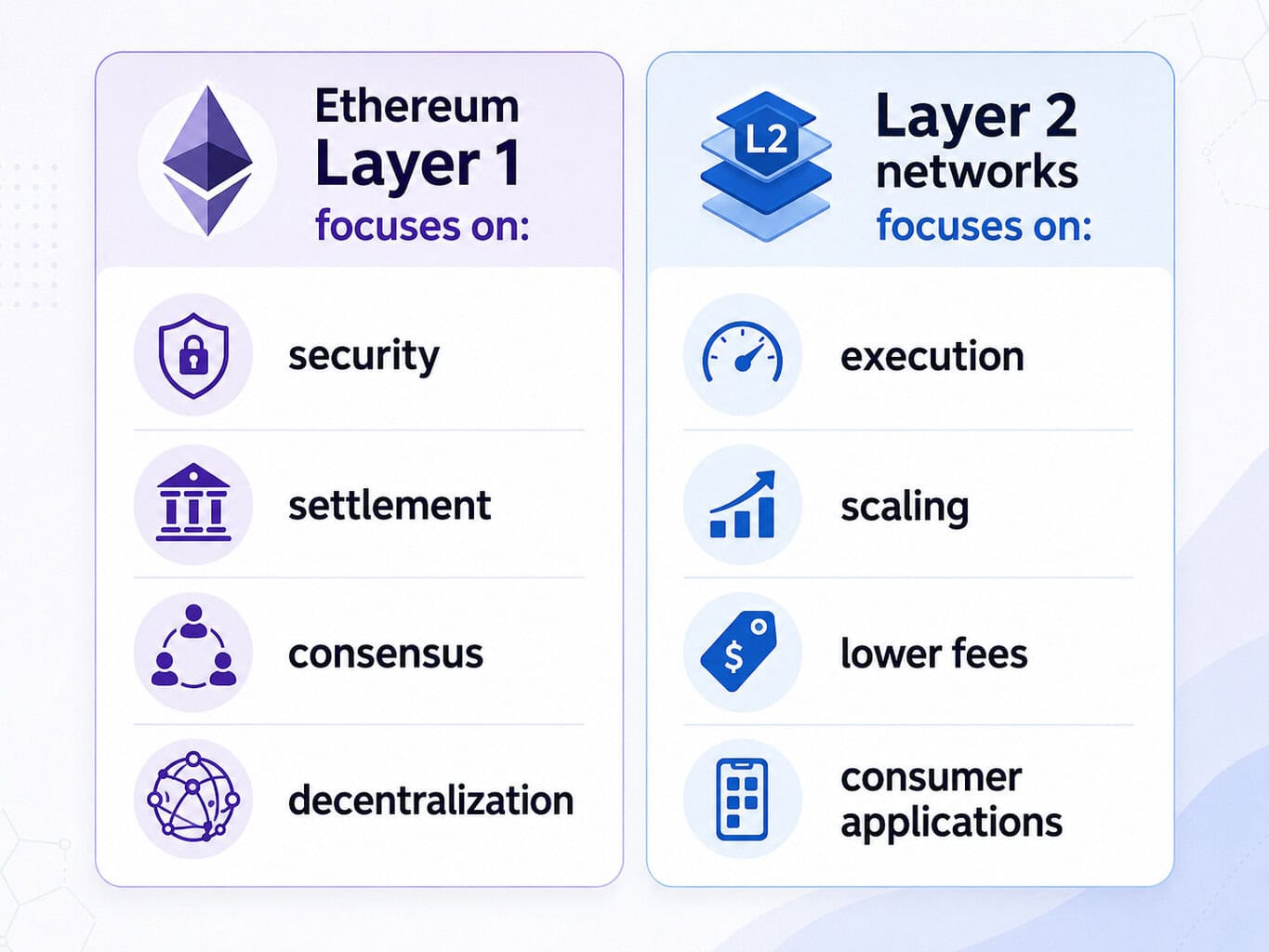
Bridges connect ecosystems together, while data availability systems help store transaction data efficiently. This structure resembles how the internet itself evolved.
The internet does not rely on one giant system doing everything simultaneously. Instead, multiple protocols and infrastructure layers work together behind the scenes.
Ethereum increasingly follows the same model.
Future blockchain users may never interact directly with the Ethereum mainnet while still relying on systems connected to Ethereum’s settlement infrastructure.
Most people using the internet today never think about TCP/IP protocols, DNS, or server infrastructure. Likewise, future blockchain users may never think about the Ethereum mainnet while using wallets, stablecoins, games, trading apps, or AI payment systems built on Layer 2 networks.
This is why many analysts increasingly describe Ethereum as financial infrastructure rather than merely another blockchain network. Infrastructure often becomes more valuable over time, even when users barely notice it directly.
Why Many People Are Writing Off Ethereum
The criticism surrounding Ethereum has intensified over the past year. You can also see how institutional positioning affects broader crypto volatility through our analysis of BTC and ETH options expiry events.
Some investors argue that Ethereum lost momentum. Others claim Layer 2 networks extract value away from ETH itself. Solana’s speed and user experience also created strong competition narratives.
You constantly hear statements like:
- Ethereum is too slow
- Ethereum fees are too high
- Layer 2s fragmented the ecosystem
- Solana replaced Ethereum
- ETH has underperformed
- Nobody uses Ethereum anymore
Yet much of that criticism ignores how Ethereum’s architecture actually evolved. Yes, users increasingly transact on Layer 2 networks. However, that does not necessarily mean they left Ethereum. In many cases, they moved into Ethereum’s broader scaling ecosystem.
Stablecoins continue relying heavily on Ethereum and Ethereum Layer 2 infrastructure, although stablecoin activity is now clearly multichain. Tron, Solana, Base, Arbitrum, and other networks also play major roles. Tokenized assets increasingly integrate with Ethereum-compatible systems. Large decentralized finance ecosystems still anchor themselves around Ethereum liquidity.
This is where cutting through the noise becomes important. Crypto markets move emotionally. Many emotional market reactions around Ethereum resemble broader crypto scams and hype cycles, where narratives shift aggressively between fear and euphoria.
Narratives change overnight. One month, a project becomes the future of finance. The next month, social media declares it dead. Bitcoin survived countless death spirals. Ethereum faced similar cycles repeatedly.
That does not guarantee Ethereum’s long-term success. Technology evolves rapidly, and there are never guarantees in crypto. However, dismissing Ethereum entirely because narratives shift temporarily often overlooks the deeper infrastructure being built beneath the surface.
The reality is far more nuanced. Ethereum may no longer dominate every narrative cycle as it did before, but it remains deeply integrated into the broader crypto economy. That distinction matters enormously for long-term investors.
Stablecoins Changed Everything
One of Ethereum’s strongest long-term growth drivers is stablecoins. Billions of dollars move daily through stablecoin ecosystems connected to Ethereum, Ethereum Layer 2 networks, and other major blockchains. Stablecoins transformed blockchain networks into payment rails.
Cross-border settlement becomes faster. Transfers become programmable. Financial applications become easier to automate. Users can move dollar-like value across blockchain networks without relying only on volatile crypto assets. This is one reason institutional interest in blockchain infrastructure continues growing.
Traditional finance increasingly experiments with:
- tokenization
- digital settlement systems
- blockchain infrastructure
- programmable finance
Ethereum’s Role in Stablecoin Infrastructure
Ethereum remains closely tied to these developments due to its developer ecosystem, liquidity, DeFi infrastructure, and settlement credibility. That does not mean Ethereum automatically wins forever.
Stablecoin activity is now multichain, and users often choose the fastest or cheapest network available. Tron, Solana, Base, Arbitrum, and other ecosystems also play important roles.
However, stablecoin ecosystems relying heavily on Ethereum and Ethereum-compatible infrastructure create a strong long-term foundation that many investors underestimate.
Why Ethereum L1 vs L2 Matters for Investors
At first glance, Layer 2 growth seems bearish for Ethereum. If users transact on Arbitrum or Base instead of the Ethereum mainnet, does Ethereum lose value? That debate became one of crypto’s hottest topics.
Ethereum supporters argue the opposite. As Layer 2 ecosystems grow:
- settlement demand increases
- Ethereum remains the security layer
- Rollups rely on Ethereum data availability
- ETH stays deeply integrated into the ecosystem
The introduction of EIP-4844, also known as proto-danksharding, accelerated this trend significantly.
This upgrade introduced blobs, a cheaper way for rollups to publish transaction data to Ethereum. The technical details behind this scaling upgrade are described in the official Ethereum EIP-4844 documentation. Layer 2 transaction fees collapsed afterward.
That made microtransactions, gaming, AI-agent payments, social applications, and stablecoin transfers more practical on Ethereum Layer 2 networks. Meanwhile, Ethereum itself continued processing enormous settlement activity. That combination surprised many analysts.
However, the debate is not one-sided. Critics argue that Layer 2s may capture too much activity and revenue themselves, while the Ethereum mainnet earns less in fees than it did during previous bull markets.
The balanced view is that Layer 2 growth is both an opportunity and a challenge. It helps Ethereum scale and attract more users, but it also forces investors to understand how value flows between the Ethereum mainnet, Layer 2 networks, applications, sequencers, validators, and ETH holders.
Ethereum L1 vs L2 vs Solana: Two Different Visions
The Ethereum versus Solana debate often becomes tribal very quickly. However, these ecosystems pursue fundamentally different scaling philosophies.
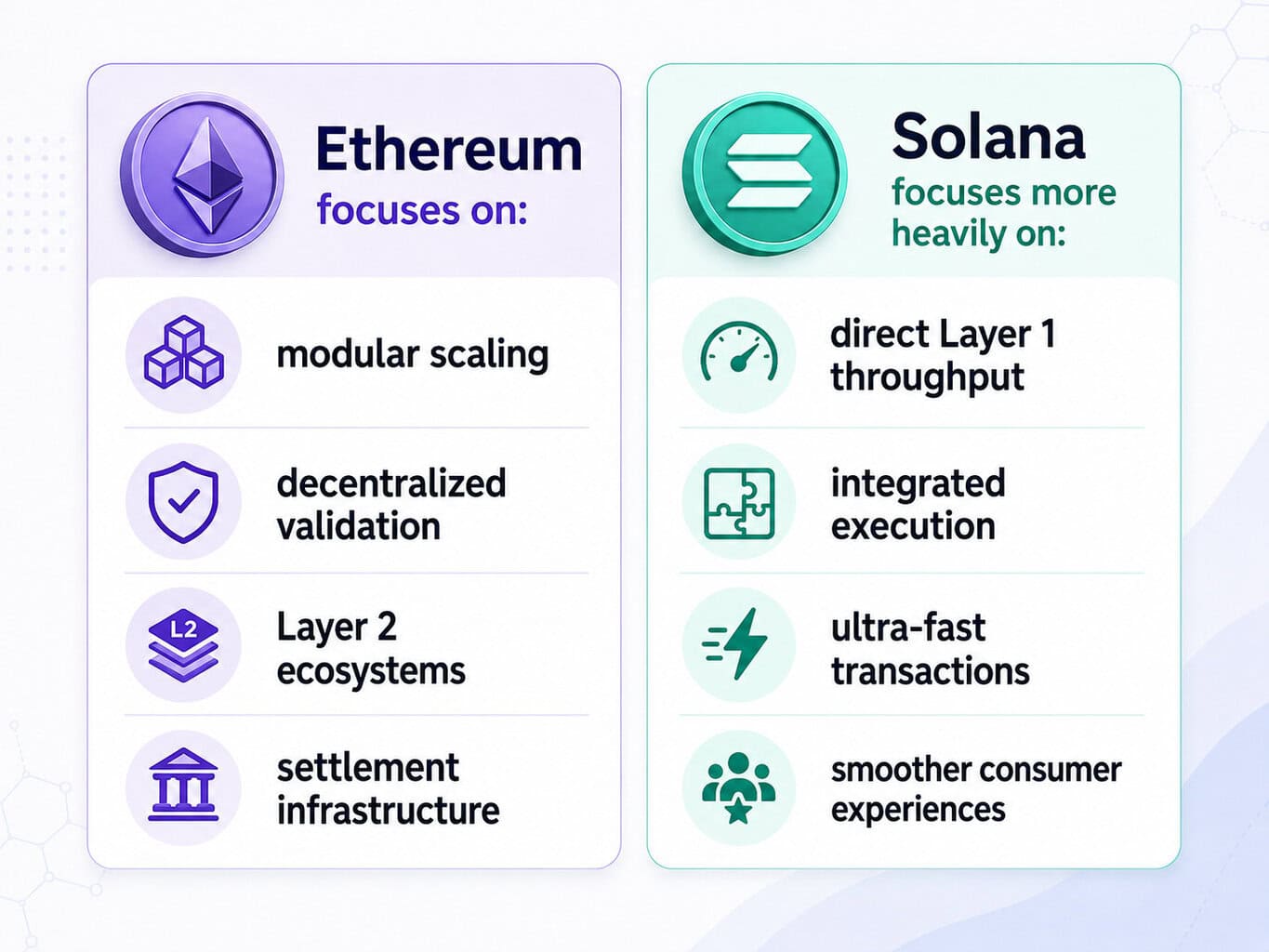
Both models have strengths. Solana often delivers a better user experience today. Transactions are fast, cheap, and simple for many retail users. That makes Solana attractive for memecoins, NFTs, gaming, trading, and consumer applications.
Ethereum offers deeper infrastructure layers, a stronger emphasis on decentralized settlement, extensive DeFi liquidity, and a large rollup ecosystem. The market may support both ecosystems long term.
Crypto does not always become winner-takes-all. Sometimes multiple ecosystems coexist because they solve different problems for different users. This is why investors should avoid turning technical differences into emotional tribalism.
Ethereum and Solana are not only competitors. They represent different visions for how blockchain infrastructure should scale.
Five Important Tips for Investors Following Ethereum Scaling
1. Do Not Judge Ethereum Only by Mainnet Activity
A huge amount of Ethereum-related activity now happens on Layer 2 networks. Looking only at Ethereum mainnet metrics creates an incomplete picture. Investors should also watch Arbitrum, Optimism, Base, zkSync, Starknet, and other Layer 2 ecosystems.
2. Watch Stablecoin Growth Carefully
Stablecoins may become one of crypto’s largest adoption drivers during the next decade. Ethereum remains deeply connected to that ecosystem, especially when Ethereum mainnet and Layer 2 activity are considered together.
3. Understand the Difference Between Execution and Settlement
This distinction matters enormously. Ethereum is increasingly focused on settlement, security, consensus, and data availability, while Layer 2s handle much of the execution.
4. Ignore Extreme Narratives
Crypto communities love overreacting. One week, Ethereum supposedly replaces banks. The next week, social media says ETH is dead. Reality usually sits somewhere in the middle.
5. Keep an Open Mind
Ethereum, Solana, Bitcoin, and other ecosystems may all play important roles in the long term. Avoid becoming trapped in tribal echo chambers. The best investors understand trade-offs rather than blindly defending a single ecosystem.
Wall Street, Ethereum, and the Cypherpunk Debate
One of the most controversial parts of Ethereum’s evolution is the growing involvement of Wall Street and large financial institutions. For many early crypto users, that feels uncomfortable. A large part of the original crypto movement came from cypherpunk ideals:
- decentralization
- financial sovereignty
- privacy
- independence from traditional banking systems
- separation from Wall Street influence
That mindset still matters. Many people entered crypto precisely because they distrusted traditional financial institutions after years of monetary expansion, banking crises, censorship, and centralized control.
So when names like JPMorgan Chase, BlackRock, or Franklin Templeton appear in connection with Ethereum and tokenization, some investors naturally feel skeptical.
Jamie Dimon of JPMorgan spent years publicly criticizing Bitcoin while the broader banking industry quietly explored blockchain infrastructure behind the scenes. Many crypto users see that as hypocrisy. Honestly, that criticism is understandable. However, reality also matters.
The crypto industry is no longer a small underground experiment
The crypto industry is no longer a small underground experiment operating completely outside the financial system. Today, large institutions increasingly explore blockchain infrastructure because tokenized finance, programmable settlement, and digital asset systems create real operational advantages.
We can fight that reality emotionally, or we can acknowledge that adoption itself changes the landscape. That does not mean crypto suddenly lost all cypherpunk values.
Some people will continue preferring privacy-focused ecosystems like Monero or more decentralized alternatives built specifically around anonymity, self-custody, and separation from institutional finance. That perspective remains completely valid.
However, Ethereum increasingly sits at the intersection between:
- decentralized finance
- institutional finance
- tokenized assets
- stablecoin infrastructure
- programmable settlement systems
Ignoring that shift does not stop it from happening. In many ways, this reflects the broader tension between ideological purity and mainstream adoption. The more successful blockchain technology becomes, the more traditional finance inevitably enters the space.
That process was always likely once trillions of dollars became involved. Whether people like it or not, major institutions are already building around tokenized blockchain infrastructure.
BlackRock launched its BUIDL tokenized money market fund on Ethereum through Securitize. Franklin Templeton expanded its tokenized fund infrastructure connected to Ethereum. JPMorgan continues to develop blockchain settlement and tokenized finance infrastructure through its own institutional systems.
This does not guarantee Ethereum will dominate the future forever. Technology evolves rapidly. However, dismissing Ethereum as irrelevant while some of the world’s largest financial institutions actively build around tokenized blockchain infrastructure misses an important part of the bigger picture.
The irony is almost poetic. The same industry originally created to move away from Wall Street is now slowly reshaping Wall Street itself.
Recent Ethereum Debate and Market Sentiment
The Ethereum debate intensified recently as prominent investors, traders, and crypto personalities questioned ETH’s market performance compared to other ecosystems. Some critics argue that Ethereum lost its edge. Others believe Layer 2 fragmentation weakened the ecosystem’s narrative strength.
Meanwhile, Ethereum supporters continue pointing toward:
- stablecoin growth
- Layer 2 adoption
- institutional settlement
- tokenization infrastructure
- long-term security advantages
One recent example of this debate can be seen across discussions surrounding Ethereum’s underperformance relative to Bitcoin and Solana during parts of the current market cycle.
At the same time, Ethereum’s infrastructure usage continues growing underneath the surface. That contradiction perfectly captures why Ethereum remains one of crypto’s most debated assets today. Crypto narratives move faster than infrastructure.
A blockchain can lose social media attention while still becoming more important behind the scenes. That is why Ethereum is difficult to judge only through price action, short-term sentiment, or mainnet transaction counts.
The better question is not whether Ethereum wins every narrative cycle. The better question is whether Ethereum continues to matter for stablecoins, DeFi, tokenization, rollups, and settlement.
Final Thoughts on Ethereum L1 vs L2
Ethereum’s Layer 1 versus Layer 2 architecture represents one of the biggest technological shifts in modern crypto. The ecosystem evolved from a simple smart contract platform into a layered financial infrastructure network.
Stablecoins, tokenization, decentralized finance, AI-driven systems, blockchain gaming, and programmable settlement increasingly interact with Ethereum-based or Ethereum-compatible infrastructure. That does not guarantee Ethereum will dominate forever.
Technology moves fast. Competition evolves continuously. Crypto markets remain volatile and emotional. However, cutting through short-term noise matters.
Ethereum is no longer competing solely on transaction speed. It increasingly functions like infrastructure underneath large parts of the digital asset economy. Most casual investors still focus only on price charts.
Meanwhile, beneath the surface, blockchain infrastructure continues to evolve quietly. And historically, understanding infrastructure early often matters far more than chasing temporary narratives. Ethereum may not win every app, every user, or every cycle.
But as long as stablecoins, tokenization, DeFi, and Layer 2 networks continue to rely on Ethereum’s settlement ecosystem, Ethereum remains one of the most important foundations of crypto infrastructure.
Ethereum L1 vs L2 Frequently Asked Questions
Ethereum Layer 1 is the base blockchain responsible for security and settlement. Layer 2 networks process transactions separately while still relying on Ethereum underneath.
Ethereum cannot efficiently process massive global demand directly on Layer 1 without compromising decentralization.
Layer 2s inherit varying levels of Ethereum security depending on their architecture and decentralization.
Rollups bundle transactions together and publish compressed transaction proofs back to Ethereum.
Many analysts believe Layer 2 growth strengthens Ethereum because rollups still rely on Ethereum settlement and security.
