

If you've spent any time in the crypto market, you've probably come across names like USDT, USDC, or DAI. These digital assets are known as stablecoins, and they have become essential tools for traders, investors, businesses, and decentralized finance platforms.
Unlike Bitcoin or Ethereum, stablecoins are designed to maintain a relatively stable value. Most are pegged to the US dollar, allowing users to move money across blockchain networks without worrying about large price swings.
That simple concept has transformed how people interact with cryptocurrencies. Stablecoins now process trillions of dollars in annual transaction volume and play a central role in crypto trading, cross-border payments, lending, and tokenized finance.
In this guide, we'll explain how stablecoins work, compare the different types available, discuss their advantages and risks, and show why they continue to grow in importance throughout 2026.
What Are Stablecoins?
A stablecoin is a cryptocurrency designed to maintain a stable price by linking its value to another asset. In most cases, that asset is the US dollar, although some stablecoins are tied to gold, other fiat currencies, or even baskets of assets, but not a next-gen coin.
The primary goal is simple. Stablecoins combine the speed and accessibility of blockchain technology with the price stability people expect from traditional currencies.
Without stablecoins, moving funds between cryptocurrencies would often require converting assets back into fiat. That process can be slow, expensive, and unavailable outside banking hours.
Stablecoins eliminate much of that friction. Instead of selling Bitcoin for dollars through a bank, traders can convert it into USDC or USDT within seconds and remain inside the crypto ecosystem. This flexibility has made stablecoins one of the foundations of modern digital finance.
Why Crypto Needed Stablecoins
Cryptocurrencies are known for their volatility. Bitcoin can gain or lose several percentage points in a single day. Smaller cryptocurrencies often experience even larger price movements. While volatility creates trading opportunities, it also complicates everyday financial activities.
Imagine receiving your salary in a cryptocurrency that loses 15% of its value before you pay your rent. Businesses and consumers need predictable purchasing power, which highly volatile assets cannot provide. Stablecoins solve this problem by offering digital assets that aim to maintain a stable value while retaining the benefits of blockchain technology.
Today they are used for:
- Trading cryptocurrencies
- Cross-border payments
- Holding temporary cash positions
- Sending international remittances
- Decentralized finance (DeFi)
- On-chain savings and lending
- Institutional settlements
- Treasury management
Their usefulness extends far beyond crypto exchanges.
Why Stablecoins Became So Important
Stablecoins have grown alongside the cryptocurrency industry. As decentralized finance expanded, users needed reliable collateral for lending and borrowing. Exchanges required stable trading pairs.
Institutional investors wanted a digital asset that could move quickly without introducing additional market risk. Stablecoins fulfilled all of these needs. Today they are widely used by:
- Retail investors
- Professional traders
- Crypto exchanges
- Investment funds
- Payment companies
- Fintech firms
- Blockchain developers
- Institutional asset managers
Their role continues to expand as more traditional financial institutions explore tokenized assets and blockchain-based settlement systems.
How Stablecoins Work
Although stablecoins share the same goal of maintaining a stable value, they achieve it using different mechanisms. The exact process depends on the type of stablecoin. Most dollar-pegged stablecoins attempt to maintain a value close to one US dollar.
Whenever demand changes, the issuing system works to keep the market price near that target. Understanding these mechanisms helps investors evaluate the strengths and risks of different stablecoins.
The Peg Mechanism
A stablecoin's peg refers to the target value it tries to maintain. For example:
- 1 USDT ≈ $1
- 1 USDC ≈ $1
- 1 FDUSD ≈ $1
If market demand pushes the price above one dollar, new tokens may be issued to increase supply. If demand falls below one dollar, redemption mechanisms or market incentives encourage the price to move back toward the peg. Although small fluctuations occur, well-managed stablecoins typically remain close to their intended value.
Reserves Keep Fiat-Backed Stablecoins Stable
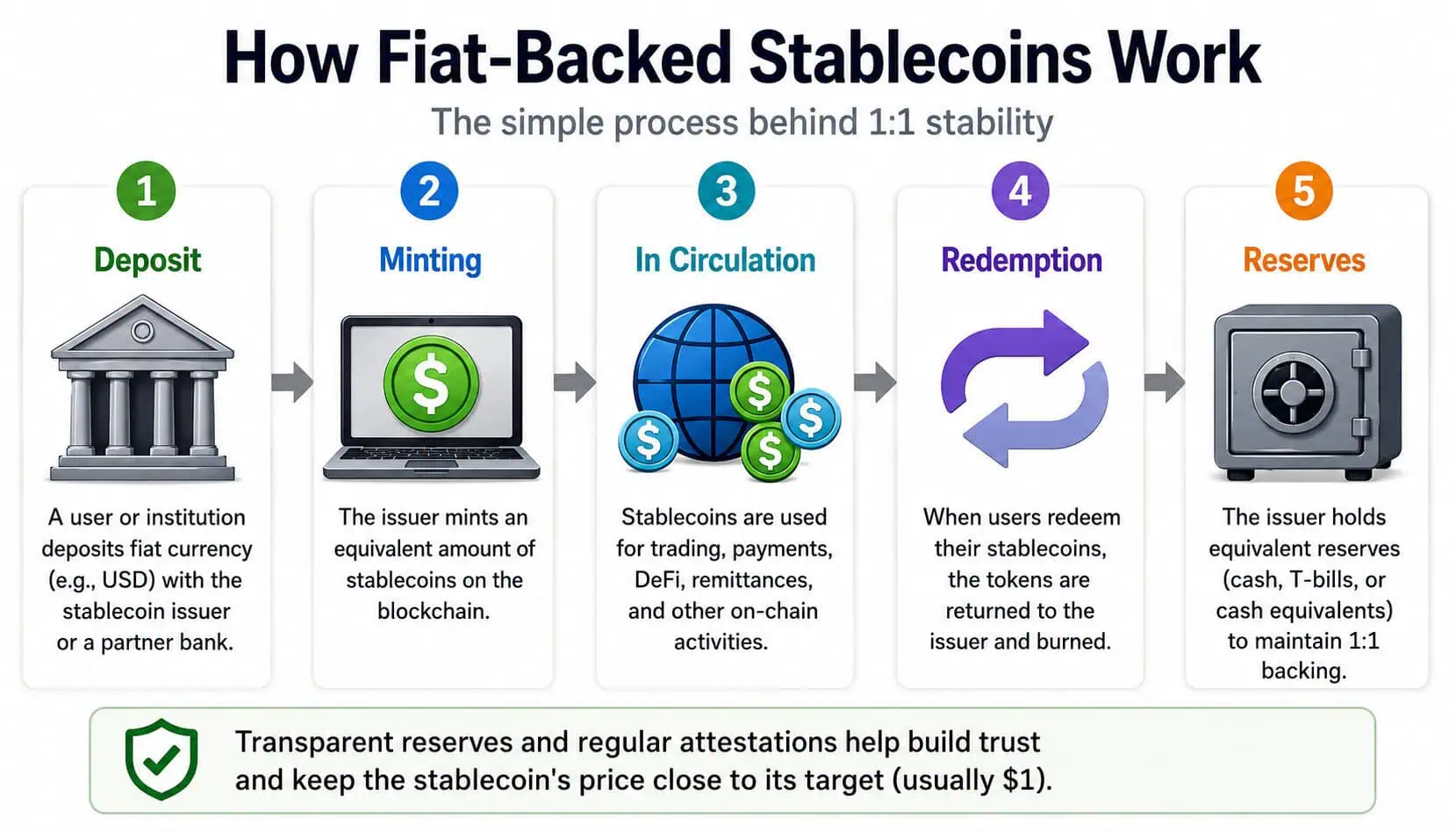
Many of today's largest stablecoins are backed by reserves held by the issuer. These reserves may include:
- Cash
- Treasury bills
- Short-term government securities
- Money market funds
- Bank deposits
- Highly liquid financial instruments
For every stablecoin issued, the company aims to hold assets of approximately equal value. This reserve-backed model gives users confidence that tokens can be redeemed when needed.
Transparency plays a major role here. Many leading issuers publish reserve reports or independent attestations that help users understand how their assets are backed.
Minting New Stablecoins
Creating new stablecoins is known as minting. Consider a simplified example:
A financial institution deposits $1 million with a stablecoin issuer. The issuer then creates one million new dollar-backed tokens. Those tokens enter circulation and can be transferred across supported blockchain networks. Because each token represents approximately one dollar in reserves, the overall supply remains backed by real-world assets.
Redemption
The reverse process is called redemption. When large holders return stablecoins to the issuer, the tokens are removed from circulation. The issuer then releases the corresponding value from its reserves.
This process helps maintain balance between supply and demand while supporting the stability of the peg. Not every retail user redeems directly with an issuer, but institutional participants play an important role in keeping market prices aligned.
Collateral Matters
Collateral is the foundation that supports many stablecoins. Depending on the project, collateral may include:
- US dollars
- Treasury bills
- Other fiat currencies
- Cryptocurrencies
- Commodities
- Tokenized financial assets
The quality, liquidity, and transparency of this collateral significantly affect a stablecoin's reliability. Assets that are easy to value and sell generally provide stronger confidence during periods of market stress.
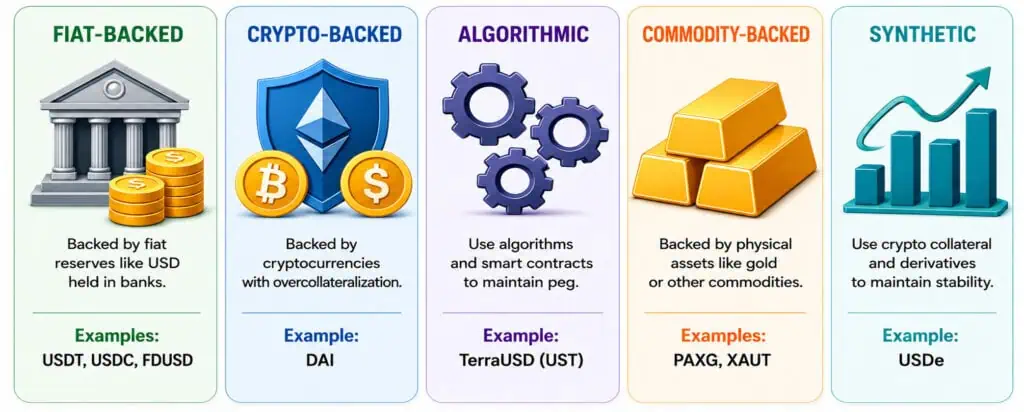
Types of Stablecoins
Not all stablecoins work the same way. The market has evolved into several distinct categories, each with its own advantages, trade-offs, and risk profile. Understanding these differences helps investors choose the right stablecoin for their goals.
Fiat-Backed Stablecoins
Fiat-backed stablecoins are the most common and widely used type. They maintain their value by holding reserves of traditional financial assets, usually denominated in US dollars. Well-known examples include:
- USDT (Tether)
- USDC (Circle)
- FDUSD (First Digital USD)
When users acquire these stablecoins, they rely on the issuer to maintain sufficient reserves and manage redemption requests. This centralized model has made fiat-backed stablecoins the dominant choice for crypto trading and payments.
| ⬆️ Advantages | ⬇️ Disadvantages |
|---|---|
| . High liquidity . Broad exchange support . Relatively stable price . Easy to understand . Widely accepted across the crypto ecosystem | . Dependence on a centralized issuer . Regulatory oversight . Possible blacklisting of wallet addresses . Users must trust reserve management |
Despite these trade-offs, fiat-backed stablecoins continue to dominate global trading volume because of their simplicity and deep liquidity.
Crypto-Backed Stablecoins
Crypto-backed stablecoins take a different approach from fiat-backed alternatives. Instead of relying on bank deposits or government securities, they use cryptocurrencies as collateral.
The best-known example is DAI, issued by the Maker protocol, which is now part of the Sky ecosystem. Rather than trusting a central company to hold reserves, users lock crypto assets into smart contracts that automatically manage the collateral.
This model aligns closely with the principles of decentralized finance (DeFi), where code replaces many of the functions traditionally performed by financial institutions.
How Overcollateralization Works
One challenge with using cryptocurrencies as collateral is their volatility. Assets like Ethereum can fluctuate significantly in price, making it difficult to maintain a stable peg. To reduce this risk, crypto-backed stablecoins are typically overcollateralized.
For example, a user may deposit $150 worth of ETH to mint $100 worth of DAI. If the collateral value falls below a required threshold, the protocol can automatically liquidate part of the position to protect the system. This extra collateral provides a buffer during periods of market volatility and helps DAI remain close to its target value.
| ⬆️ Advantages | ⬇️ Disadvantages |
|---|---|
| . Greater decentralization . Transparent on-chain collateral . Reduced reliance on banks . Native integration with DeFi protocols | . More complex for beginners . Higher collateral requirements . Liquidation risk during sharp market declines . Dependent on smart contract security |
While DAI has maintained a strong reputation over the years, it also demonstrates that decentralization often entails additional complexity.
Algorithmic Stablecoins
Algorithmic stablecoins attempt to maintain their value without relying entirely on traditional collateral. Instead, they use algorithms and economic incentives to balance supply and demand.
When demand increases, new tokens may be created. When demand falls, tokens may be removed from circulation or paired with secondary assets designed to absorb volatility.
In theory, this creates a self-regulating system. In practice, maintaining confidence during periods of market stress has proven extremely difficult.
The TerraUSD (UST) Collapse
No discussion of algorithmic stablecoins is complete without mentioning TerraUSD (UST). UST maintained its peg through an arbitrage mechanism involving the LUNA token rather than fully backed reserves.
When market confidence collapsed in 2022, both UST and LUNA entered a downward spiral. Billions of dollars in value disappeared within days, making it one of the largest failures in cryptocurrency history.
The event reshaped how regulators, institutions, and investors evaluate stablecoin designs. Today, most investors prefer stablecoins backed by transparent reserves or significant collateral rather than purely algorithmic mechanisms.
| ⬆️ Advantages | ⬇️ Disadvantages |
|---|---|
| . Capital-efficient design . Potentially decentralized . Reduced dependence on traditional banking infrastructure | . Highly dependent on market confidence . Vulnerable during extreme volatility . Complex economic models . Higher historical failure rate |
The collapse of UST serves as a reminder that stability requires more than clever tokenomics. Trust, liquidity, and transparency are equally important.
Commodity-Backed Stablecoins
Not every stablecoin tracks the US dollar. Some are backed by physical commodities, allowing investors to gain blockchain-based exposure to assets such as gold or precious metals.
Instead of representing one dollar, each token represents ownership or a claim on a specific amount of the underlying commodity. Gold-backed stablecoins are the most common example. They combine the portability of blockchain technology with the historical appeal of precious metals.
How Commodity-Backed Stablecoins Differ
Unlike dollar-backed stablecoins, commodity-backed tokens are not designed to maintain a fixed purchasing power. Their value changes alongside the underlying commodity. For example, if gold rises by 15%, a gold-backed token should appreciate by a similar amount.
This makes them suitable for investors seeking long-term wealth preservation rather than a stable cash equivalent. They can also provide easier access to precious metals without the need for physical storage or transportation.
| ⬆️ Advantages | ⬇️ Disadvantages |
|---|---|
| . Exposure to real-world assets . Potential hedge against inflation . Easier transfer than physical commodities . Suitable for long-term diversification | . Price fluctuates with the commodity . Lower liquidity than major dollar-backed stablecoins . Less commonly accepted on exchanges |
Synthetic Stablecoins
Synthetic stablecoins represent one of the newest developments in decentralized finance. Rather than being directly backed by dollars held in a bank account, they maintain their value through derivative positions, hedging strategies, or other financial mechanisms.
One of the most discussed examples in 2026 is USDe. Unlike traditional reserve-backed stablecoins, USDe combines collateral with delta-neutral trading strategies to target a stable dollar value.
This approach has attracted significant interest because it aims to reduce dependence on conventional banking infrastructure while remaining scalable.
Understanding Synthetic Exposure
Synthetic stablecoins create economic exposure instead of holding equivalent cash reserves. Their stability depends on:
- Hedging strategies
- Derivatives markets
- Counterparty management
- Risk controls
- Market liquidity
This structure differs fundamentally from both fiat-backed and crypto-backed stablecoins. Although innovative, it introduces additional complexity that investors should understand before allocating significant funds.
| ⬆️ Advantages | ⬇️ Disadvantages |
|---|---|
| . Innovative design . Reduced reliance on traditional banks . Deep integration with DeFi . Potential for efficient capital use | . Greater complexity . Reliance on derivatives markets . Counterparty and execution risk . Less familiar to new investors |
As with any financial innovation, understanding how a synthetic stablecoin generates stability is just as important as understanding its advertised benefits.
Most Popular Stablecoins Compared
Choosing the right stablecoin depends on your goals. Some prioritize liquidity. Others focus on decentralization or transparency. The table below highlights the strengths and weaknesses of today's most widely used stablecoins.
| Stablecoin | Type | Backing | Transparency | Decentralization | Best Use | Strengths | Weaknesses |
|---|---|---|---|---|---|---|---|
| USDT | Fiat-backed | Cash and reserve assets | Moderate | Low | Trading and liquidity | Largest market share, broad exchange support | Centralized issuer, regulatory scrutiny |
| USDC | Fiat-backed | Cash and US Treasuries | High | Low | Payments and institutional use | Strong transparency, regulated issuer | Centralized and subject to compliance rules |
| DAI | Crypto-backed | Overcollateralized crypto assets | High | High | DeFi and decentralized finance | Transparent, decentralized governance | More complex and subject to collateral volatility |
| FDUSD | Fiat-backed | Cash equivalents | High | Low | Exchange trading | Growing exchange adoption, transparent reserves | Smaller ecosystem than USDT and USDC |
| USDe | Synthetic | Crypto collateral and hedging strategies | Moderate | Medium | DeFi and yield strategies | Innovative design and capital efficiency | More complex risk profile |
No single stablecoin is objectively the best. Many experienced investors diversify across multiple issuers to reduce concentration risk while benefiting from different ecosystems.
Understanding Stablecoin Risks
Although stablecoins are designed to reduce volatility, they are not risk-free. Every stablecoin carries its own combination of operational, financial, technological, and regulatory risks. Understanding these risks helps investors make better decisions and avoid unnecessary surprises.
Depegging Risk
The most obvious risk is losing the peg. A stablecoin trading at $0.98 instead of $1 may not seem dramatic, but larger deviations can quickly undermine confidence.
History has shown that maintaining a peg becomes increasingly difficult during periods of market panic. Most leading stablecoins have experienced temporary depegs at some point, although many recovered quickly.
Issuer Risk
Centralized stablecoins depend on the financial health and operational integrity of the issuing company. Users rely on the issuer to:
- Maintain sufficient reserves
- Process redemptions
- Manage operational risks
- Comply with regulations
A lack of transparency can reduce market confidence and increase uncertainty.
Regulatory Risk
Governments around the world continue to develop frameworks for digital assets. Future regulations may affect:
- Reserve requirements
- Redemption rights
- Licensing
- Reporting obligations
- Cross-border availability
For investors, regulatory clarity may boost confidence, but rule changes can also affect how certain stablecoins operate.
Smart Contract Risk
Decentralized stablecoins rely on smart contracts rather than centralized institutions. Although blockchain code removes some traditional intermediaries, software bugs remain a possibility. Well-audited protocols reduce this risk, but no system can eliminate it entirely.
Liquidity Risk
Liquidity determines how easily users can buy or sell a stablecoin without affecting its price. Major stablecoins generally have deep liquidity across global exchanges. Smaller projects may experience wider spreads or reduced availability during volatile market conditions.
Counterparty Risk
Some stablecoins depend on banks, custodians, derivatives providers, or trading firms. If one of these counterparties experiences financial difficulties, it could indirectly affect the stablecoin's operations. Understanding who holds reserves and how they are managed remains an important part of due diligence.
Blacklisting and Freezing
Many centralized stablecoins include compliance features that allow wallet addresses to be frozen under specific legal circumstances. While these tools help combat fraud and financial crime, they also illustrate the trade-off between regulation and decentralization. Investors who prioritize censorship resistance often prefer decentralized alternatives for this reason.
Exchange Risk
Many users leave stablecoins on centralized exchanges for convenience. However, exchange failures have demonstrated that custody risk extends beyond the stablecoin itself. Holding assets in a personal wallet reduces dependence on third-party platforms.
Stablecoins vs CBDCs
Stablecoins and Central Bank Digital Currencies (CBDCs) may appear similar because both are digital representations of fiat money. However, they serve different purposes and are issued by different entities.
Stablecoins are created by private companies or decentralized protocols. Their value is usually linked to an existing currency, most commonly the US dollar.
CBDCs, on the other hand, are digital versions of national currencies issued directly by central banks. They represent an official liability of the issuing government rather than a private issuer. The table below highlights the main differences.
| Feature | Stablecoins | CBDCs |
|---|---|---|
| Issuer | Private company or decentralized protocol | Central bank |
| Backing | Reserves, crypto collateral, or synthetic mechanisms | National currency and central bank |
| Main Purpose | Trading, payments, DeFi, settlements | Digital cash and monetary policy |
| Availability | Global, depending on the blockchain | Typically limited to participating jurisdictions |
| Programmability | Often highly programmable | Depends on the central bank's design |
| Privacy | Varies by issuer and blockchain | Depends on government policy |
Many analysts expect stablecoins and CBDCs to coexist rather than compete directly. Stablecoins are likely to remain popular in global crypto markets, while CBDCs may focus on domestic payment systems and public infrastructure.
Stablecoins vs Traditional Bank Accounts
Holding stablecoins is not the same as keeping money in a savings account. A bank account offers government-regulated financial services, while stablecoins provide a blockchain-based alternative for transferring and storing value. Each option has distinct advantages.
| Feature | Stablecoins | Bank Account |
|---|---|---|
| Availability | 24/7 | Banking hours for many services |
| Settlement | Minutes or seconds | Often one to several business days internationally |
| Cross-border transfers | Simple | Can be slow and expensive |
| Accessibility | Anyone with a compatible wallet | Requires a bank relationship |
| Yield opportunities | Available through lending and DeFi (with additional risk) | Savings interest where offered |
| Regulation | Depends on issuer and jurisdiction | Strong banking regulations |
For many crypto users, stablecoins complement traditional banking rather than replace it. A trader may receive a salary in a bank account while using stablecoins to move funds between exchanges or participate in decentralized finance.
Stablecoins vs Tokenized Gold
Although both exist on blockchain networks, stablecoins and tokenized gold serve different investment purposes. Dollar-backed stablecoins prioritize price stability. Gold-backed tokens aim to track the market value of physical gold. That difference influences how investors use each asset.
| Stablecoins | Tokenized Gold | |
|---|---|---|
| Best suited for: | . Holding purchasing power . Trading cryptocurrencies . Short-term cash management . International transfers . Portfolio liquidity | . Long-term wealth preservation . Inflation hedging . Portfolio diversification . Exposure to precious metals |
Investors concerned about inflation often include both assets in a diversified portfolio. Stablecoins provide liquidity, while tokenized gold offers exposure to an asset that has historically preserved value over long periods.
Why Stablecoins Matter in 2026
Stablecoins have evolved far beyond their original purpose as trading pairs. They now support many of the fastest-growing areas of digital finance.
Institutional Adoption Continues to Grow
Large financial institutions increasingly recognize stablecoins as an efficient settlement layer. Banks, payment providers, and asset managers continue exploring blockchain infrastructure to reduce settlement times and operational costs. Rather than replacing existing financial systems overnight, stablecoins are gradually becoming another tool within modern financial markets.
Tokenization Is Expanding
Tokenized financial assets continue to gain momentum. Government bonds, money market funds, private credit, and real-world assets are increasingly represented on blockchain networks. Stablecoins often serve as the settlement asset, enabling these markets to function efficiently.
Cross-Border Payments
International transfers remain expensive in many parts of the world. Stablecoins offer an alternative that can settle transactions within minutes, regardless of banking hours. For freelancers, international businesses, and global payment providers, this efficiency can significantly reduce costs and waiting times.
Decentralized Finance
Stablecoins remain the backbone of decentralized finance. They are widely used for:
- Lending
- Borrowing
- Liquidity pools
- Decentralized exchanges
- Yield generation
- Derivatives
Without stable assets, many DeFi applications would become significantly more volatile and difficult to use.
Crypto Exchanges
Most cryptocurrency trading pairs are denominated in stablecoins rather than fiat currencies. This allows traders to move quickly between positions without leaving the crypto ecosystem. As trading volumes grow, stablecoins continue to provide the liquidity that powers global exchanges.
How Traders Use Stablecoins
Professional traders rarely leave all of their capital invested in volatile cryptocurrencies. Stablecoins provide flexibility and help manage risk throughout different market conditions. Common use cases include:
Preserving Capital
During uncertain markets, traders often convert part of their portfolios into stablecoins rather than selling into fiat. This allows them to reduce volatility while remaining ready to re-enter the market quickly.
Using Stablecoins with Crypto Signal Groups
Many active traders keep a portion of their portfolio in stablecoins while waiting for high-conviction trade setups. This allows them to react quickly without transferring money back from a bank account. If you're looking for quality trading opportunities, explore our guide to the best Crypto Signals Groups on Telegram to compare leading free and premium groups.
Moving Between Exchanges
Different exchanges offer different trading opportunities. Stablecoins make it easier to transfer capital between platforms without relying on traditional banking systems.
Futures Collateral
Many derivatives exchanges accept stablecoins as collateral for perpetual futures and margin trading. Because the collateral itself remains relatively stable, traders can manage positions more predictably.
Buying Market Dips
Holding stablecoins gives traders immediate purchasing power when attractive opportunities appear. Instead of waiting for a bank transfer, they can deploy capital almost instantly.
Portfolio Rebalancing
Stablecoins also simplify portfolio management. Investors frequently rebalance by temporarily moving profits into stablecoins before allocating capital to new opportunities.
How Investors Use Stablecoins
Long-term investors benefit from stablecoins differently than active traders. Their focus is often on flexibility, diversification, and liquidity.
Diversification
Holding part of a portfolio in stablecoins can reduce overall volatility. Although stablecoins do not eliminate investment risk, they provide a relatively stable allocation within a broader crypto portfolio.
Emergency Liquidity
Unexpected opportunities or expenses may require immediate access to funds. Stablecoins allow investors to keep capital readily available without fully exiting the blockchain ecosystem.
Passive Income Opportunities
Some platforms allow users to earn yield on stablecoin deposits. However, higher returns generally involve higher counterparty or protocol risk. Investors should carefully evaluate any lending platform before committing funds.
Risk Management
Many investors gradually move profits into stablecoins after strong market rallies. This approach helps protect gains while maintaining flexibility for future investments.
How to Choose the Right Stablecoin
There is no universally perfect stablecoin. The best choice depends on how you intend to use it. Consider the following factors before deciding:
Transparency
Look for issuers that regularly publish reserve reports or independent attestations. Greater transparency generally improves investor confidence.
Reserve Quality
Not all reserves are equal. Cash and short-term government securities are generally considered lower-risk than less-liquid assets.
Liquidity
Choose stablecoins with strong trading volume and broad exchange support. High liquidity usually results in tighter spreads and easier conversions.
Regulation
Consider how the issuer operates within its regulatory environment. Greater regulatory oversight may improve confidence for some users, while others may prioritize decentralization.
Blockchain Compatibility
Different stablecoins operate across different blockchain networks. Make sure the stablecoin you choose is available on the network you intend to use. Compatibility can affect transfer costs, transaction speed, and ecosystem support.
You should read our post “Top 5 Stablecoins: A Guide to the Best to Use” to better understand.
Why Understanding Stablecoins Matters
Stablecoins have become one of the most important innovations in digital finance. They combine the speed of blockchain technology with the relative stability of traditional currencies, making them useful for traders, long-term investors, businesses, and financial institutions alike.
As regulation matures and tokenized assets become more common, stablecoins are expected to play an even larger role in global payments and digital asset markets.
Whether you use them to preserve capital during volatile markets, transfer funds internationally, or participate in decentralized finance, understanding how stablecoins work will help you make more informed decisions.
If you're building your crypto knowledge, continue exploring the related SmartOptions guides on stablecoins, crypto exchanges, wallets, trading bots, precious metals, and crypto investing to better understand how these technologies fit into a well-rounded investment strategy.
Related Articles
- Top 5 Stablecoins: A Guide to the Best to Use
- USDC vs USDT: Which Stablecoin Is Better in 2026?
- Why Banks Are Interested in Stablecoins in 2026
- Real World Asset Tokenization: The Next Phase of Blockchain Adoption?
- Crypto Invoice Payments Made Easy: Ultimate 2026 Guide
- How to Cash Out Crypto: The Complete 2026 Guide.
- 12 Best Crypto Wallets: Security, Cost & Coin Support Review
- Top 10 Countries in Global Crypto Adoption Index in 2025
