

This post is also available in:
 Português
Real World Asset Tokenization Is Bringing Traditional Finance On-Chain
Real World Asset Tokenization has quickly become one of the most important developments in the cryptocurrency industry. While previous market cycles were dominated by narratives surrounding decentralized finance, NFTs, and speculative altcoins, institutional investors are increasingly focusing on practical blockchain applications.
This shift is significant because it addresses one of the biggest questions surrounding the industry. Beyond cryptocurrency trading, how can blockchain technology improve existing financial markets?
For many financial institutions, the answer is becoming clear. Blockchain networks can improve settlement efficiency, reduce operational costs, increase transparency, and expand access to investment opportunities. Consequently, some of the world's largest asset managers and banks are actively exploring tokenization initiatives.
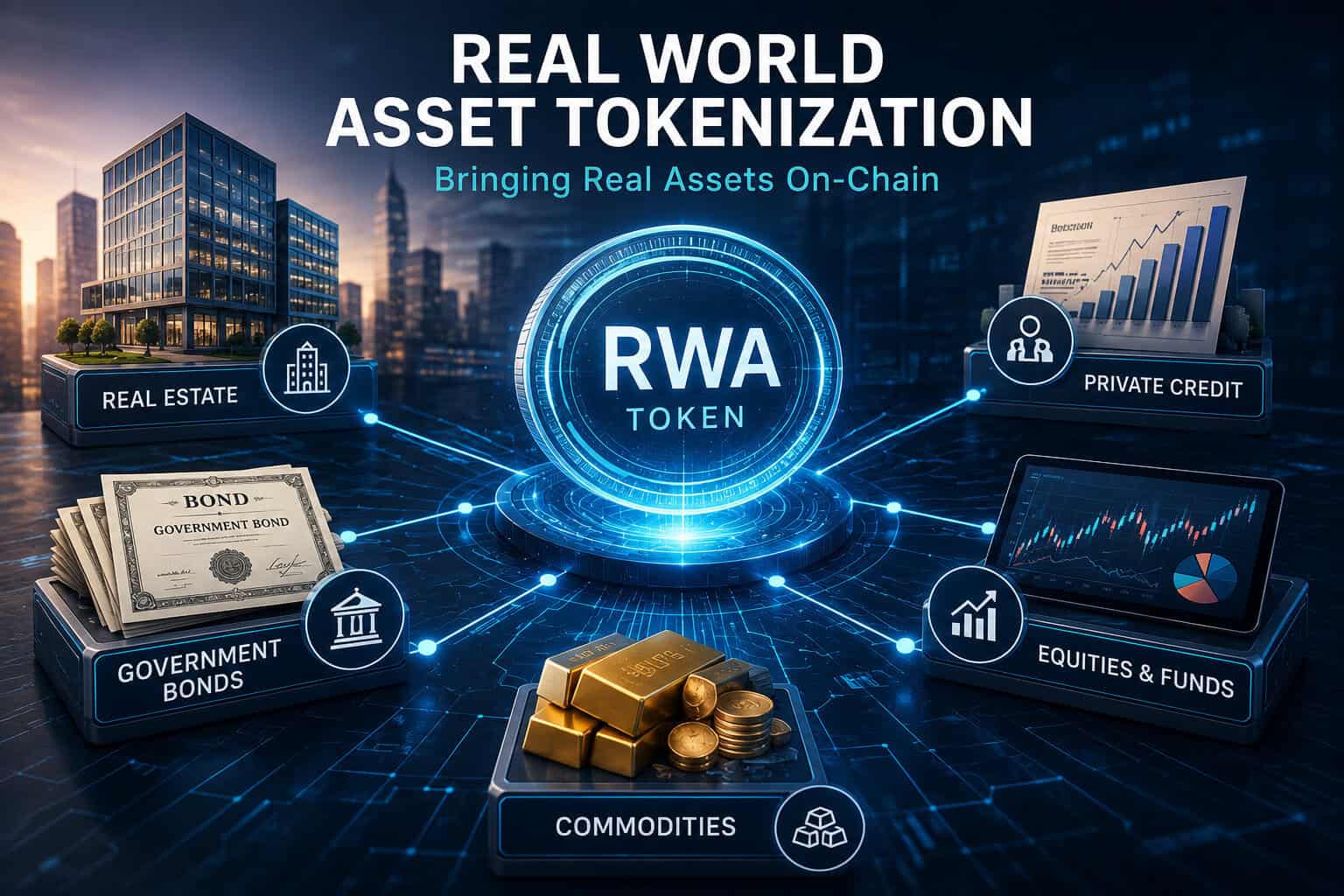
At its core, Real World Asset Tokenization involves converting ownership rights of traditional assets into blockchain-based tokens. These tokens can represent assets such as real estate, government bonds, corporate debt, commodities, and investment funds.
Unlike many crypto narratives that rely heavily on speculation, Real World Asset Tokenization focuses on improving existing systems. Therefore, it has attracted significant institutional interest and may become one of the most important long-term trends in blockchain adoption.
Why Real World Asset Tokenization Is Growing So Quickly
Every crypto cycle introduces new trends. However, only a few develop into lasting components of the financial system. Stablecoins provide one of the best examples.
Stablecoins successfully connected traditional currencies with blockchain networks. As a result, they created a foundation that supports trading, payments, and decentralized applications. If you are unfamiliar with their role within the ecosystem, read our guide: Top 5 Stablecoins: A Guide to the Best to Use.
Today, many analysts believe Real World Asset Tokenization could represent the next stage of blockchain adoption. Instead of bringing digital assets to investors, tokenization brings traditional financial assets onto blockchain networks.
This distinction matters because the potential market is enormous. Government bonds, real estate, private credit, commodities, and investment funds collectively represent hundreds of trillions of dollars in value. Consequently, even limited adoption could significantly expand the size of blockchain-based financial markets.
As institutional participation increases, tokenization is evolving from an experimental concept into a practical financial solution.
Why Traditional Finance Supports Real World Asset Tokenization
Traditional financial infrastructure remains surprisingly inefficient in several areas. Although modern technology has improved communication and market access, many transactions still require multiple intermediaries, lengthy settlement processes, and extensive administrative work.
Blockchain technology offers a different approach. Ownership records can be stored and transferred through distributed ledgers, creating transparent and verifiable transaction histories. Furthermore, blockchain systems can reduce settlement times and improve operational efficiency.
Liquidity is another major factor driving adoption. Many traditional assets remain difficult to trade. Real estate serves as a clear example. Buying or selling property often involves significant legal documentation, financing requirements, and lengthy negotiation processes.
Through Real World Asset Tokenization, ownership can be divided into smaller units. Consequently, investors may gain exposure to assets that were previously inaccessible due to high capital requirements.
For financial institutions, the appeal extends beyond accessibility. Reduced costs, improved transparency, and broader investor participation all contribute to the growing interest in tokenization.
How Real World Asset Tokenization Works in Practice
The concept becomes easier to understand through a practical example. Imagine a commercial office building valued at $10 million. Under a traditional ownership structure, participation generally requires substantial capital and access to private investment opportunities.
With Real World Asset Tokenization, ownership can be divided into digital tokens that represent portions of the building. Instead of one investor purchasing the entire asset, thousands of investors can hold fractional ownership. As a result, participation becomes more accessible, while ownership transfers may become more efficient.
Importantly, the token itself does not create value. The value derives from the legal framework that connects the token to the underlying asset. Therefore, successful tokenization projects require both strong technological infrastructure and clear legal structures. As the industry matures, these models may be applied across an increasingly wide range of financial assets.
The Leading Real World Asset Tokenization Sectors
Tokenized Treasury Bonds
Government bonds have emerged as one of the strongest examples of successful Real World Asset Tokenization. Investors are increasingly seeking yield-generating opportunities within blockchain ecosystems. Therefore, tokenized treasury products have attracted significant attention. These products combine exposure to traditional fixed-income assets with the operational advantages of blockchain infrastructure.
Tokenized Real Estate
Real estate remains one of the most promising sectors for tokenization. Historically, property investments required substantial capital commitments. Additionally, liquidity has often been limited. Through tokenization, investors may gain access to fractional ownership opportunities while benefiting from increased flexibility.

Private Credit and Investment Funds
Private credit and investment funds are also attracting attention. Traditionally, these opportunities were largely restricted to institutional investors. However, tokenization may gradually expand access while improving reporting and transparency. As a result, many analysts view these sectors as important areas of future growth.
Ethereum and the Infrastructure Behind Real World Asset Tokenization
Although tokenized assets receive most of the attention, the underlying blockchain infrastructure remains critical. Ethereum currently dominates institutional tokenization initiatives. Its security, developer ecosystem, and established infrastructure make it a preferred choice for many organizations.
However, scalability remains an important consideration. Consequently, many projects are also utilizing Layer 2 solutions to improve efficiency and reduce transaction costs. To better understand these differences, read our guide on Ethereum L1 vs L2.
Other blockchain networks such as Avalanche, Polygon, and Solana are also competing for tokenization projects. Nevertheless, the broader trend remains clear. Institutions are increasingly evaluating blockchain networks as infrastructure rather than speculation vehicles.
Can Real World Asset Tokenization Become Bigger Than DeFi?
This is one of the most important questions facing the industry. Decentralized finance demonstrated that blockchain networks could support lending, borrowing, trading, and other financial services. However, most DeFi activity remained limited to assets already within the crypto ecosystem.
Real World Asset Tokenization significantly expands opportunities. Instead of competing for existing crypto capital, tokenization introduces entirely new asset classes. Consequently, the addressable market is dramatically larger.
The global value of stocks, bonds, real estate, commodities, and private markets exceeds hundreds of trillions of dollars. Even a relatively small percentage moving on-chain could transform blockchain-based finance. For this reason, many analysts consider tokenization one of the strongest long-term blockchain narratives currently developing.
How Real World Asset Tokenization Could Affect Crypto Investors
For investors, Real World Asset Tokenization represents more than another emerging trend. It signals the gradual integration of blockchain technology with traditional finance. As a result, future growth may come not only from cryptocurrencies but also from the digitization of existing financial assets.
Investors interested in emerging blockchain sectors may also find value in our guide covering the Top 7 Next-Gen Coins. Meanwhile, traders seeking active market opportunities can explore our research on the best Telegram crypto signal groups.
While the long-term outlook remains promising, investors should remember that regulatory frameworks, market structures, and adoption rates are still evolving.
Final Thoughts
Real World Asset Tokenization is gradually moving from concept to implementation. Unlike many short-lived narratives, tokenization addresses practical challenges that have existed within traditional finance for decades. Consequently, institutional adoption continues to expand even during periods of market uncertainty.
The sector still faces challenges. Regulatory clarity, legal frameworks, and liquidity remain important areas of development. Nevertheless, the overall direction appears increasingly positive. According to the World Economic Forum, tokenization has the potential to improve transparency, accessibility, and efficiency across multiple financial sectors.
Whether Real World Asset Tokenization ultimately becomes larger than DeFi remains uncertain. However, it is already establishing itself as one of the most important developments in the ongoing evolution of blockchain finance.
