

This post is also available in:
 Português
If you've spent any time in crypto, you've probably heard people say things like “We're almost entering a bull market again,” or “The bear market is almost over.” At first, those statements can sound like little more than educated guesses. However, after following Bitcoin for years, one thing becomes clear: patterns known as Crypto Market Cycles mean that crypto rarely moves randomly.
Instead, it moves in cycles:
- Bitcoin usually leads.
- Altcoins follow later. (not always)
- Psychology matters.
- Risk management beats prediction.
Understanding crypto market cycles completely changed the way I look at investing. Rather than reacting to every price swing or headline, I started asking a much simpler question:
Which phase of the market are we actually in?
That single question often tells you far more than watching the price chart every five minutes.
While no one can predict the future with certainty, market cycles provide a framework. They help explain why prices rise for months, why corrections happen when everyone feels optimistic, and why the best buying opportunities often appear when nobody wants to own crypto.
In this guide, I'll explain how crypto market cycles work, why Bitcoin usually leads each cycle, why altcoins follow, and how experienced investors adapt their strategies during each phase.
Whether you're investing for the first time or looking to improve your trading decisions, understanding market cycles is one of the most valuable skills you can develop.
What Is a Crypto Market Cycle?
A crypto market cycle is the recurring pattern of rising and falling prices that develops over time. Instead of moving in a straight line, cryptocurrencies experience periods of growth, consolidation, decline, and recovery.
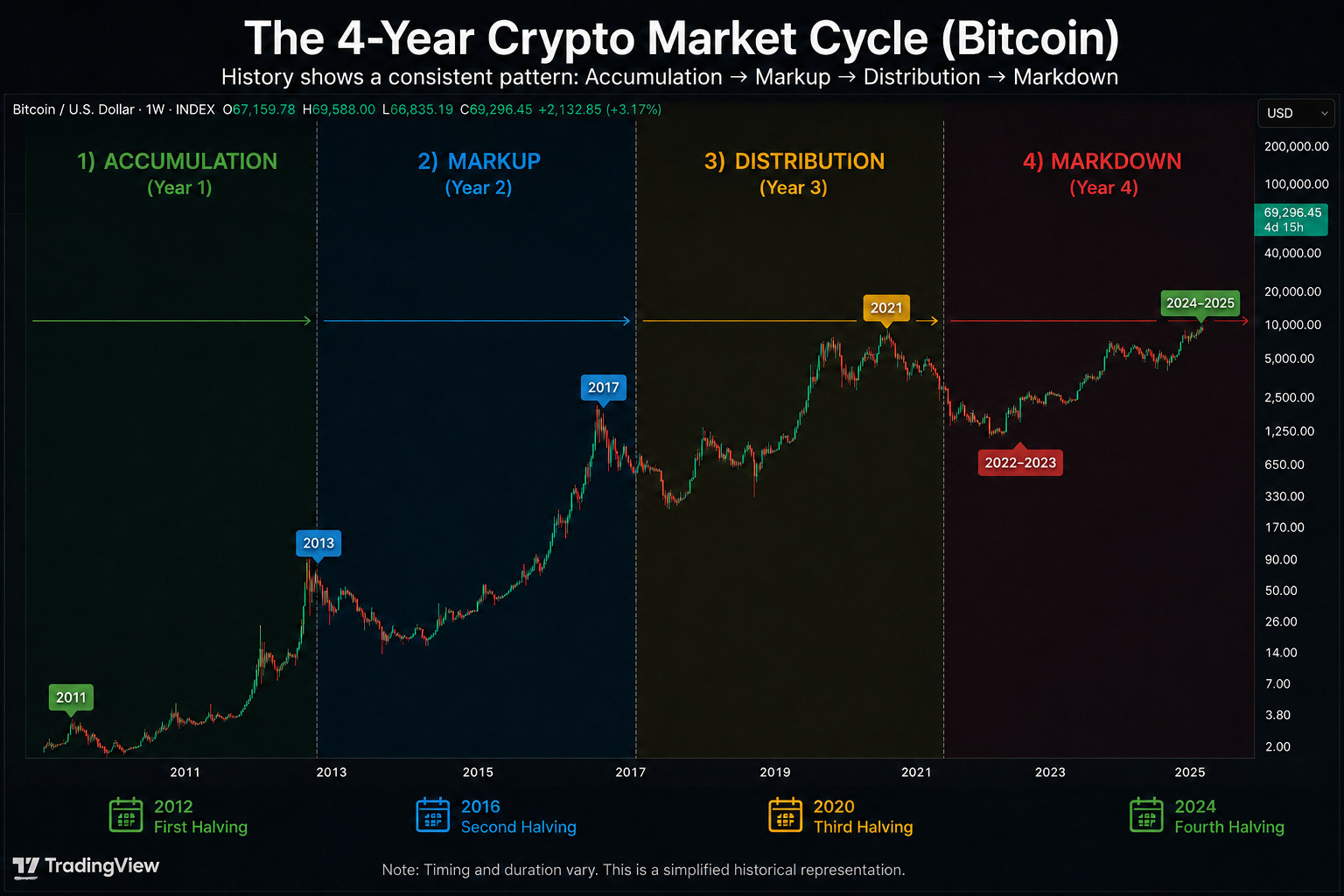
Every cycle is different, but they tend to follow a familiar rhythm. Markets become undervalued. Buyers slowly return. Momentum builds. Optimism spreads. Prices accelerate. Eventually, expectations become unrealistic, profit-taking begins, and the market corrects before the process starts all over again.
Bitcoin has followed this pattern since its earliest years. Although each cycle has been influenced by different events, including the launch of spot Bitcoin ETFs, macroeconomic policy, institutional adoption, and technological innovation, the underlying structure has remained remarkably consistent.
This isn't unique to crypto, either: stocks, commodities, real estate, and even entire economies move through cycles. The difference is that cryptocurrencies tend to experience these phases much faster and with significantly greater volatility.
That volatility creates opportunity, but only for investors who understand what they're looking at.
Why Crypto Markets Move in Cycles
Many people assume cryptocurrency prices simply rise because more people buy Bitcoin. While that's partly true, the reality is much more complex. Every crypto market cycle is shaped by several powerful forces working together, including supply and demand, Bitcoin's halving events, investor psychology, and broader economic conditions. Understanding how these factors interact makes it much easier to recognize where the market is today and where it could be heading next.
Supply and Demand
Like any financial market, cryptocurrency prices are ultimately driven by supply and demand. When demand grows faster than the available supply, prices rise. On the other hand, when more investors want to sell than buy, prices fall.
Bitcoin makes this relationship even more interesting because its supply is permanently limited to 21 million coins. Unlike traditional currencies, no central bank can create more Bitcoin whenever it chooses. As adoption increases and more investors compete for a limited supply, scarcity naturally becomes an increasingly important driver of price. This simple economic principle forms the foundation of every Bitcoin market cycle.
Bitcoin Halving
One of Bitcoin's most unique characteristics is its halving event. Approximately every four years, the reward miners receive for validating transactions is halved, reducing the number of new Bitcoins entering circulation.
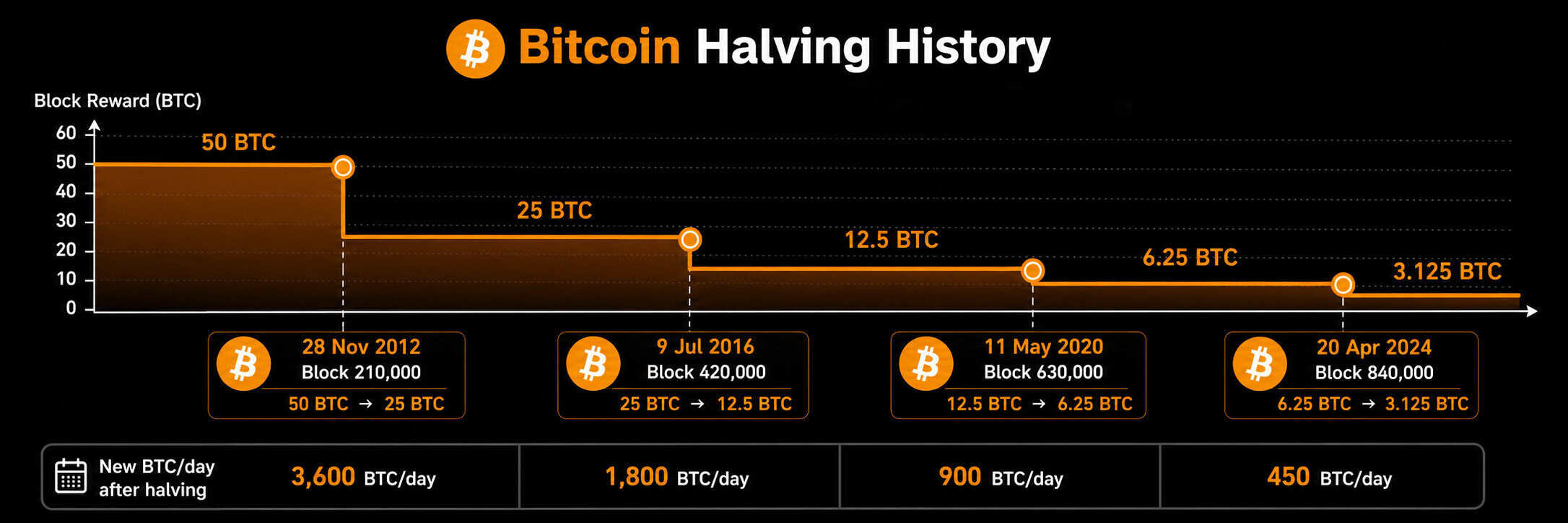
Historically, each halving has reduced miners' selling pressure while demand has continued to grow. Although a halving doesn't automatically trigger a bull market, previous cycles have shown a strong relationship between reduced supply and long-term price appreciation. That's why many investors view the Bitcoin halving as the beginning of a new market cycle, even though it's only one of several factors influencing price.
Investor Psychology
Markets don't move because charts tell them to. They move because people make emotional decisions every single day.
Fear and greed have influenced financial markets for centuries, and crypto is no exception. During a bull market, positive news attracts new investors, social media fills with success stories, and friends who never showed an interest in Bitcoin suddenly want to know how to buy it. Confidence gradually turns into overconfidence, and many investors begin to believe prices can only continue to move higher.
Eventually, reality catches up. When prices start falling, optimism quickly turns into anxiety, anxiety becomes fear, and fear often leads to panic selling. Ironically, many investors buy near the top because everyone feels confident, then sell near the bottom because everyone feels scared.
Understanding this emotional cycle has been far more valuable to me than trying to predict the next candle on a price chart.
Macroeconomic Conditions
Although Bitcoin is decentralized, it doesn't exist in isolation. Interest rates, inflation, central bank policy, liquidity, and global economic conditions all influence how much risk investors are willing to take.
When borrowing becomes cheaper and liquidity increases, investors generally become more comfortable allocating money to higher-risk assets such as cryptocurrencies. When interest rates rise and capital becomes more expensive, that appetite for risk usually declines. We've seen this pattern play out repeatedly over the past decade, reminding us that crypto is still part of the wider financial system.
Institutional Adoption
One of the biggest differences between today's market and previous crypto cycles is the growing participation of institutional investors.
For many years, Bitcoin was primarily owned by retail investors. Today, pension funds, hedge funds, family offices, publicly traded companies, and some of the world's largest asset managers all have exposure to digital assets. The approval of spot Bitcoin ETFs has further accelerated this trend by making Bitcoin accessible through regulated investment products.
Institutional adoption doesn't remove volatility, but it does change the type and scale of money entering the market. As more long-term capital flows into Bitcoin, future crypto market cycles may become more mature, more stable, and potentially less extreme than those we've experienced in the past.
The Four Phases of Crypto Market Cycles
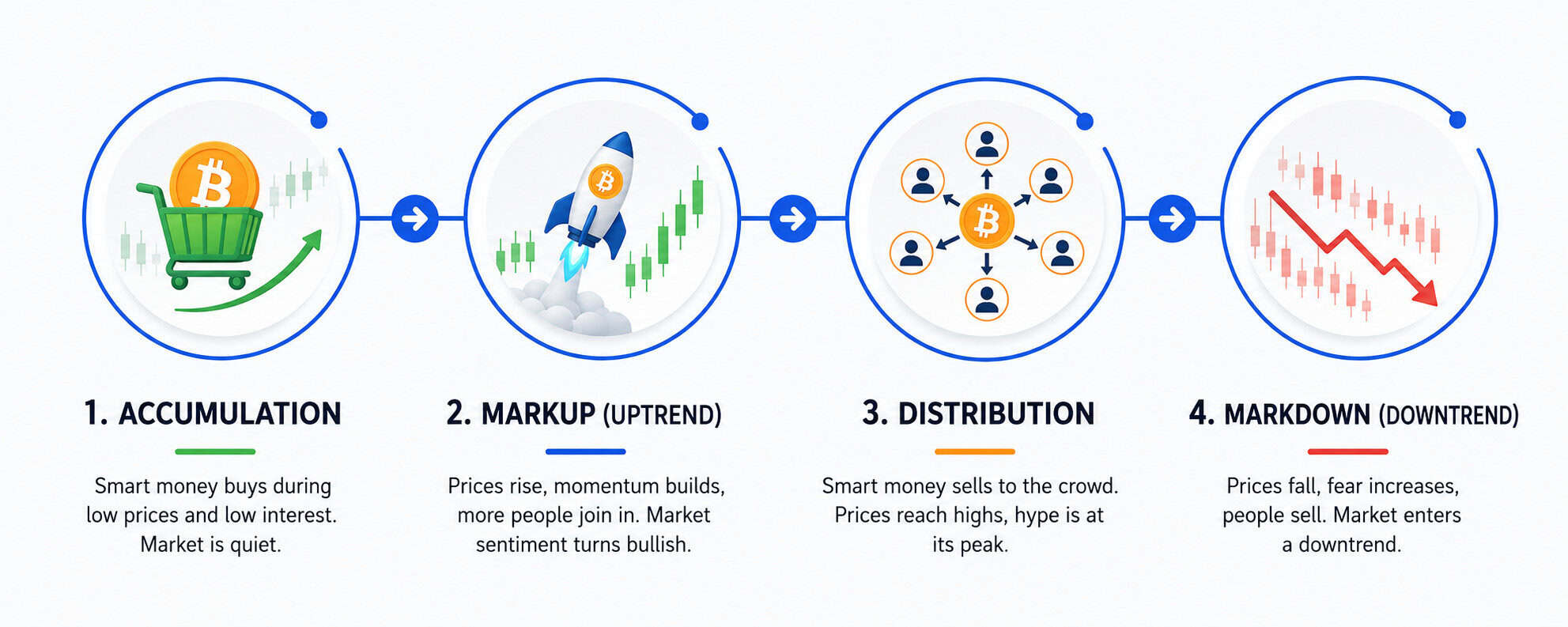
Although no two crypto market cycles are identical, they almost always move through the same four phases. The timing may differ, and every cycle has its own catalysts, but the overall pattern has remained surprisingly consistent throughout Bitcoin's history.
Learning to recognize these phases won't help you predict the exact market top or bottom. Nobody can do that consistently. What it will do is give you a better understanding of why prices behave as they do, allowing you to make more informed decisions rather than reacting emotionally to every move.
Accumulation
The accumulation phase begins after a prolonged bear market, when confidence in crypto is at its lowest. Most investors have already given up, trading volumes are relatively low, and media attention has largely disappeared. Instead of making dramatic moves, prices often trade within a narrow range as the market searches for a new direction.
For many people, this is the most boring part of the cycle. There are few exciting headlines, social media becomes much quieter, and it feels like nothing is happening. Ironically, that's exactly why experienced investors often pay the closest attention during this period.
Rather than chasing momentum, they slowly begin building long-term positions while sentiment remains negative. Because competition from emotional buyers is limited, investors can focus on research instead of reacting to fear or hype.
Looking back at previous Bitcoin market cycles, accumulation never felt obvious in real time. Only months later does it become clear that this was the period when some of the best long-term opportunities appeared.
Markup
Eventually, demand outstrips supply, and the market begins to build momentum. Bitcoin begins making higher highs and higher lows, confidence slowly returns, and technical indicators become increasingly positive. Institutional investors often start increasing their exposure, while retail investors gradually begin paying attention again.
This is where a new bull market starts taking shape.
One mistake I see repeatedly is investors assuming the first strong rally marks the end of the opportunity. After prices rise by 20% or 30%, many people convince themselves they've already missed the move and either sell too early or wait for a correction that never comes.
In reality, the markup phase often lasts much longer than expected. Strong trends tend to continue, and the largest gains often occur after the initial breakout, once confidence spreads across the broader market.
Understanding this has made me far more patient over the years. Instead of trying to predict every short-term top, I focus on whether the broader trend remains healthy.
Distribution
No bull market lasts forever.
Eventually, prices rise much faster than fundamentals, optimism reaches extreme levels, and almost everyone becomes convinced that the market can only continue moving higher. Financial news reports new all-time highs almost daily, social media fills with screenshots of extraordinary profits, and suddenly everyone seems to have discovered a winning investment strategy.
This is known as the distribution phase.
Unlike accumulation, distribution is incredibly difficult to recognize while you're living through it. Prices can continue climbing for weeks or even months, making it easy to believe there's still plenty of upside ahead. Behind the scenes, however, long-term investors often begin taking profits. Institutions gradually reduce their exposure, while newer investors continue buying because they don't want to miss out.
I've learned that trying to sell at the exact top is almost impossible. Instead, I prefer reducing exposure gradually as optimism becomes increasingly excessive. Selling a little too early is usually a much better outcome than trying to exit after the market has already begun to turn lower.
Markdown
After the distribution phase, the market enters a markdown phase. Selling pressure begins outweighing demand, prices trend lower, and confidence slowly fades. At first, many investors believe it's simply another healthy correction, especially because Bitcoin has recovered from similar pullbacks in previous bull markets.
As the decline continues, sentiment changes. Investors who bought near the highs begin questioning their decisions, media coverage becomes increasingly negative, and trading activity slows. What started as optimism gradually turns into uncertainty, then fear, and eventually panic.
This is where many investors make their biggest mistake. Instead of following a long-term plan, they react emotionally and sell after substantial losses simply because they can no longer tolerate the uncertainty.
Ironically, the markdown phase also lays the foundation for the next crypto market cycle. While many participants leave the market, patient investors continue to research, build positions, and prepare for future opportunities. Every major Bitcoin bull market has begun after a period of overwhelmingly negative sentiment.
Without markdown, there would be no accumulation, and without accumulation, the next cycle could never begin.
How Bitcoin Leads Crypto Market Cycles
If there's one constant throughout crypto history, it's this: Bitcoin almost always moves first.
Why Bitcoin Moves First
As the largest cryptocurrency by market capitalization, Bitcoin attracts the majority of institutional investment, ETF inflows, media attention, and regulatory focus. When confidence begins returning to the market, investors typically see Bitcoin as the safest entry point into crypto. That makes it the benchmark for almost every new market cycle.
During the early stages of a recovery, most of the new capital entering the market flows into Bitcoin. Institutions, asset managers, and large investors generally prioritize liquidity and lower risk before considering smaller cryptocurrencies. As Bitcoin gains momentum and investor confidence grows, that capital gradually starts spreading across the rest of the market.
How Capital Rotates Through the Crypto Market
This pattern has repeated throughout multiple crypto market cycles. Bitcoin usually leads the initial rally, Ethereum often follows shortly afterward, and only later do investors begin allocating capital to larger altcoins, mid-cap projects, and eventually smaller, more speculative cryptocurrencies.
Although every cycle develops differently, this progression has historically been common. However, recent ETF-driven inflows have shown that Bitcoin can maintain market leadership for much longer before capital rotates into the broader altcoin market. Understanding it can help explain why some parts of the market remain quiet even as Bitcoin reaches new highs. It doesn't necessarily mean those projects are underperforming. In many cases, the market is simply following its normal rotation.
One indicator that many investors use to monitor this process is Bitcoin Dominance. This measures Bitcoin's share of the total cryptocurrency market capitalization and provides insight into where capital is flowing.
When Bitcoin Dominance rises, Bitcoin generally outperforms the rest of the market. Investors are prioritizing safety, liquidity, and the market leader over higher-risk alternatives. When Bitcoin Dominance begins to fall during a bull market, it often signals that capital is rotating into Ethereum and other altcoins, including many next-gen coins, as investors become more comfortable taking on additional risk.
Like any indicator, Bitcoin Dominance shouldn't be used on its own. However, when combined with market structure, investor sentiment, and broader macroeconomic trends, it can provide valuable context for understanding where the current crypto market cycle may be heading next.
Recognizing Bitcoin's leadership doesn't mean ignoring altcoins. Instead, it helps set realistic expectations. More often than not, the strongest opportunities appear when you understand where capital is likely to flow before the rest of the market catches on.
Why Altcoins Usually Follow Bitcoin
One of the most common questions I receive is why altcoins often lag behind Bitcoin during the early stages of a bull market. The answer is actually quite straightforward.
Bitcoin attracts the largest pools of capital first. Institutional investors, asset managers, and large funds rarely begin by buying small-cap cryptocurrencies. Instead, they allocate capital to Bitcoin because it's the most liquid, the most established, and generally considered the lowest-risk crypto asset. As confidence grows and Bitcoin delivers strong returns, investors gradually become more willing to move further along the risk curve in search of higher potential gains.
That's usually when Ethereum starts outperforming. As momentum builds, attention spreads to other large-cap cryptocurrencies before eventually reaching mid-cap and smaller altcoins. By the final stages of a bull market, investors often become comfortable taking far greater risks, leading to explosive price movements in speculative sectors such as meme coins and newly launched tokens.
A simplified version of this capital rotation often looks like this:

Of course, every market cycle is different, and the timing is never exactly the same. Historically, capital has often rotated from Bitcoin into Ethereum and later into larger and smaller altcoins. However, the ETF-driven market cycle of 2024 and 2025 demonstrated that strong institutional demand can keep capital concentrated in Bitcoin for much longer than previous bull markets. Understanding those differences is just as important as recognizing the historical pattern.
One pattern we've also noticed while publishing our SmartOptions monthly signal reports is that Bitcoin-focused trades often begin outperforming before most altcoin signals improve. Although each month is different, the overall performance of many providers has often reflected the same capital rotation seen in previous market cycles. Seeing that pattern play out in real trading results has reinforced why I pay close attention to where capital is flowing, rather than focusing only on which coins are already making headlines.
Understanding this rotation has made me much more patient as an investor. Just because an altcoin hasn't moved yet doesn't necessarily mean it's underperforming or that the project has failed. Sometimes it's simply a matter of waiting for Bitcoin to complete the next phase of its rally before capital begins flowing into the rest of the market.
In my experience, many newer investors become frustrated when their altcoins don't immediately follow Bitcoin higher. They switch between projects, chasing whatever has already gone up. More often than not, that leads to buying late and selling early. Having patience and understanding where capital is likely to flow next has proven to be a much more effective long-term strategy.
Market Psychology During Every Phase
If I had to choose one factor that separates successful investors from everyone else, it wouldn't be technical analysis or finding the next hidden gem. It would be emotional control.
Every crypto market cycle is driven by human psychology. Prices don't just move because of charts or economic data. They move because millions of people make emotional decisions every day. That's why understanding market psychology is just as important as understanding support and resistance or reading an RSI indicator.
How Emotions Drive Every Crypto Market Cycle
I've seen it happen in every cycle. When prices are low, almost nobody wants to buy. People become convinced that crypto is finished, the media focuses on negative headlines, and investors lose interest. Then Bitcoin quietly starts climbing. At first, very few people believe the rally will last, but as prices continue rising, confidence slowly returns. Investors who stayed on the sidelines begin buying because they don't want to miss out.
Eventually, confidence turns into euphoria. People quit their jobs to trade full-time. Every new token promises life-changing returns, leverage becomes normal, and risk management disappears. That is usually when experienced investors become cautious.
The cycle then begins to reverse. Small corrections become larger ones; optimism turns into uncertainty; uncertainty becomes fear; and fear eventually becomes panic. After months of declining prices, many investors simply give up. Ironically, that's often where the next bull market quietly begins. If you prefer guidance instead of navigating every market cycle alone, following experienced analysts through trusted crypto signals and groups can help you stay disciplined and filter out much of the market noise.
A Simple Question That Prevents Emotional Decisions
One of the best habits I've developed is asking myself a simple question before making any investment decision:
Am I buying because my research tells me to, or because everyone else is?
That single question has saved me from making countless emotional decisions over the years.
| Bull Market | Bear Market |
|---|---|
| Optimism and confidence | Fear and uncertainty |
| Rising prices | Falling prices |
| Strong buying momentum | Selling pressure dominates |
| High trading activity | Lower trading activity |
| Investors take more risk | Investors focus on capital preservation |
| FOMO drives many decisions | Panic selling becomes common |
How Experienced Traders Adapt During Each Phase
Understanding crypto market cycles is only valuable if it changes the way you invest. The goal isn't to predict every market top or bottom. Instead, it's about adjusting your expectations and strategy based on the phase the market appears to be in.
Strategies for Every Stage of the Market Cycle
Here's a simplified overview of how experienced investors often approach each stage of the cycle.
| Market Phase | Typical Strategy | Primary Focus |
|---|---|---|
| Accumulation | Dollar-cost averaging (DCA) and building long-term positions | Patience and research |
| Markup | Holding winners while following the trend | Let profits run |
| Distribution | Gradually taking profits and reducing exposure | Risk management |
| Markdown | Protecting capital and preparing for the next opportunity | Capital preservation |
Stay Flexible as the Market Changes
Notice something important. Nowhere does the strategy say to buy because everyone on social media is bullish. Likewise, it doesn't suggest selling everything simply because prices are falling.
Experienced investors usually make decisions before the crowd catches on. That doesn't mean they're always right. It simply means they already have a plan before emotions take over.
This is also where technical analysis becomes valuable. Indicators like the Relative Strength Index (RSI), moving averages, trendlines, and support and resistance levels can help identify changes in momentum. However, they should never be used in isolation.
The best decisions come from combining technical analysis with an understanding of the broader market cycle. If you'd like to dive deeper into these concepts, I recommend reading our guides on a beginner's guide to trading and the Stock-to-Flow Model after finishing this article.
Common Mistakes Investors Make
Every crypto market cycle creates new winners, but it also creates plenty of avoidable mistakes. I've made some of them myself, especially during my early years in crypto. Fortunately, they're also some of the easiest mistakes to avoid once you recognize them.
Buying Because Everyone Else Is Buying
This is probably the most common mistake I see during every bull market. After prices have already increased significantly, investing suddenly feels safe. Friends start talking about Bitcoin again, financial news covers crypto every day, and social media fills with screenshots of impressive gains. It's easy to believe the market can only continue moving higher.
Unfortunately, that's often when risk is at its highest. The strongest part of the rally may already be behind you, while experienced investors are quietly taking profits. Instead of buying just because everyone else seems confident, I prefer to ask whether the fundamentals and the current market cycle still support the investment.
Selling During Maximum Fear
The opposite usually happens during a bear market. After months of falling prices, confidence disappears, and negative headlines dominate the news. Many investors become convinced that crypto will never recover, even though history shows that every major Bitcoin bear market has been followed by a new period of growth.
That doesn't mean prices can't fall further. It simply means emotional decisions rarely lead to good investment outcomes. Some of the best long-term buying opportunities have appeared when sentiment was at its worst, not when everyone felt optimistic.
Ignoring Risk Management
No investment goes up forever, and even Bitcoin has experienced multiple declines of more than 70% throughout its history. If your portfolio depends entirely on one trade succeeding, you're taking unnecessary risk.
Position sizing, diversification, and realistic expectations matter far more than finding the perfect entry price. Preserving your capital gives you the opportunity to benefit from future market cycles instead of being forced out after one bad decision.
Using Too Much Leverage
Leverage can amplify gains, but it also amplifies losses. During highly volatile markets, even good trades can be liquidated simply because the leverage used was too aggressive.
I've always believed it's better to survive multiple crypto market cycles than to maximize returns during just one. Capital preservation gives you another opportunity tomorrow. A liquidation doesn't.
Believing “This Time Is Different”
Every bull market has its own story. Sometimes it's DeFi, NFTs, or Bitcoin ETFs. More recently, it has been artificial intelligence and growing institutional adoption for the crypto space.
While the narratives change, investor behavior rarely does. Whenever people begin saying that traditional market rules no longer apply, I become more mindful. History doesn't repeat perfectly, but it often rhymes.
How I Approach Crypto Market Cycles
Over the years, my own approach has become much simpler. I no longer try to predict every short-term price movement. Instead, I spend more time trying to understand where we are in the bigger picture.
If I believe we're still in the early stages of a market cycle, I'm generally comfortable holding quality positions despite normal corrections. If markets become extremely optimistic and valuations start to look detached from reality, I'll slowly reduce exposure rather than chase even higher prices.
The word “slowly” is important. I don't believe anyone can consistently time the exact top or bottom of a market. Instead, I prefer making gradual decisions as the market evolves. That removes much of the emotional pressure that comes with trying to be exactly right.
Another important habit to develop is separating investing from trading. My long-term investments follow the broader market cycle, while my short-term trades are based on technical setups and risk management. Keeping those strategies separate prevents me from making emotional decisions that don't fit either plan.
Most importantly, I remind myself that another opportunity will always come. Crypto has rewarded patience far more often than it has rewarded impulsive decisions, and understanding market cycles has helped me stay focused on the bigger picture instead of getting caught up in short-term noise.
Can You Predict the Next Crypto Market Cycle?
One of the questions I hear most often is whether it's possible to predict the next crypto market cycle.
The honest answer is no. Nobody can consistently predict the exact top or bottom of the market, no matter how confident they sound. If someone claims they know exactly where Bitcoin will trade next month or when the next bull market will begin, they're making an educated guess rather than stating a fact.
That doesn't mean investors are flying completely blind. While it's impossible to predict every price movement, it's possible to identify conditions that have historically influenced crypto market cycles. Looking at these factors together provides a much clearer picture than focusing on a single indicator.
Indicators That Can Help Identify a Market Cycle
One of the most important events is the Bitcoin halving. Every four years, the amount of new Bitcoin entering circulation is reduced, thereby limiting new supply. Historically, each halving has been followed by a period of significant price appreciation, although the timing and magnitude have varied from cycle to cycle. Past performance never guarantees future results, but the relationship between reduced supply and increasing demand is difficult to ignore.
Macroeconomic conditions also play a major role. Interest rates, inflation, global liquidity, and investor confidence all influence how much capital flows into risk assets such as cryptocurrencies. When financial conditions improve, investors are generally more willing to allocate capital to Bitcoin and the broader crypto market.
Another valuable source of information comes from on-chain data. Metrics such as long-term holder activity, exchange balances, realized profits and losses, and network participation can provide insight into how investors are behaving beneath the surface. While these indicators don't predict the future, they often help explain whether the market is becoming overheated or whether sentiment remains relatively healthy.
Focus on Probabilities, Not Perfect Predictions
I also pay close attention to market sentiment. When everyone believes prices can only continue moving higher, I become more cautious. Likewise, when fear dominates the market and many investors have already given up, I start paying much closer attention to potential opportunities. Extreme optimism and extreme pessimism have repeatedly marked important turning points throughout previous crypto market cycles.
Over the years, I've found that understanding probabilities is far more valuable than trying to make perfect predictions. Instead of asking where Bitcoin will be next week, I focus on whether the overall environment supports higher prices or suggests that risks are increasing. That shift in mindset removes much of the pressure to constantly guess the next move.
Ultimately, successful investing isn't about predicting every market cycle perfectly. It's about recognizing where we are, managing risk appropriately, and remaining disciplined regardless of what the market does tomorrow. Investors who consistently follow a well-defined strategy usually outperform those who spend their time searching for the perfect prediction.
Turn Market Cycle Knowledge Into Better Decisions
Of course, understanding crypto market cycles is only one piece of the puzzle. Successful investing also requires sound risk management, technical analysis, and continuous learning. The more tools you have available, the easier it becomes to make informed decisions instead of emotional ones.
If you're serious about becoming a better crypto investor, I recommend continuing with some of our other educational guides. Learning how to read price charts, identify support and resistance levels, understand indicators like the RSI, and manage your portfolio will help you put the concepts from this article into practice.
No strategy wins every trade, and no investor gets every decision right. However, those who remain disciplined, keep learning, and understand how markets evolve over time are usually best positioned to succeed over the long term.
The goal isn't to predict every move. It's about recognizing the bigger picture, staying patient when others become emotional, and making better decisions throughout every crypto market cycle to build a complete investment or trading strategy.
Final Thoughts
For me, crypto market cycles are impossible to predict with complete accuracy, but they aren't random either. Throughout Bitcoin's history, the market has repeatedly moved through the same broad phases of optimism, growth, excess, decline, and recovery. While every cycle is driven by different events, human behavior has remained remarkably consistent.
Understanding that bigger picture can give you a significant advantage over investors who focus only on short-term price movements. Instead of reacting to every headline or chasing the latest trend, you begin asking more important questions. Where are we in the current cycle? Has sentiment become too optimistic? Are prices supported by fundamentals, or is emotion driving the market?
That shift in perspective has completely changed the way I invest. After following multiple crypto market cycles, teachings from Erik (SmartOptions Plus), and comparing their performance with that of the crypto signal providers we track each month at SmartOptions, I've become far less interested in predicting every market top or bottom. Instead, I focus on managing risk, staying patient, and making decisions that align with the broader market environment rather than the emotions of the day.
I have found that understanding where the market is in its cycle is far more valuable than trying to predict what Bitcoin will do tomorrow. That doesn't mean I always get it right. I still make mistakes and continue learning with every market cycle. However, viewing the market through that broader lens has helped me make more consistent and disciplined investment decisions over the years.
Frequently Asked Questions
Crypto market cycles are the recurring periods of growth, decline, and recovery that the cryptocurrency market experiences over time. Rather than moving in a straight line, Bitcoin and other cryptocurrencies typically pass through four stages: accumulation, markup, distribution, and markdown. Understanding these phases helps investors make more informed decisions instead of reacting emotionally to short-term price movements.
There is no fixed timeframe for a crypto market cycle. Historically, complete Bitcoin market cycles have often lasted around four years, largely influenced by the Bitcoin halving. However, macroeconomic conditions, institutional adoption, regulation, and market sentiment can all affect the length of a cycle. Some phases may last only a few months, while others can continue for much longer.
Several factors work together to create crypto market cycles. Supply and demand, Bitcoin halvings, investor psychology, macroeconomic conditions, institutional investment, and liquidity all influence market behavior. No single factor determines the market's direction, but together they create the recurring patterns that have appeared throughout Bitcoin's history.
Bitcoin is the largest and most established cryptocurrency, making it the first choice for many institutional and retail investors when confidence returns to the market. As Bitcoin gains momentum, investors gradually become more willing to take additional risk, causing capital to rotate into Ethereum and eventually into other altcoins.
No one can consistently predict the exact top or bottom of a crypto market cycle. While indicators such as the Bitcoin halving, macroeconomic trends, on-chain data, and investor sentiment can provide valuable clues, they should be viewed as probabilities rather than guarantees. Successful investing is usually based on preparation and risk management rather than perfect predictions.
Bear markets can provide attractive long-term opportunities because prices are often significantly lower than during bull markets. However, they also carry considerable risk, and prices may continue falling before recovering. Many experienced investors use strategies such as dollar-cost averaging to gradually build positions instead of trying to perfectly time the bottom.
Bitcoin Dominance measures Bitcoin's share of the total cryptocurrency market capitalization. When Bitcoin Dominance increases, Bitcoin is generally outperforming the rest of the market. When it declines during a bull market, it often indicates that investors are rotating capital into Ethereum and other altcoins.
No single indicator can identify the exact stage of a crypto market cycle. Instead, investors typically look at a combination of price trends, trading volume, market sentiment, macroeconomic conditions, Bitcoin Dominance, and on-chain data. Looking at the bigger picture usually provides a more reliable assessment than focusing on a single metric.
Many experienced investors adapt their strategy depending on where they believe the market is in the cycle. During accumulation, the focus is often on building positions. During strong uptrends, investors may let winners run while managing risk. As markets become increasingly euphoric, gradually taking profits can help reduce exposure before sentiment eventually turns. The exact approach depends on your goals, risk tolerance, and investment horizon.
One of the most common mistakes is allowing emotions to drive investment decisions. Many investors buy after prices have already risen significantly because they fear missing out, then sell during sharp declines because they're afraid prices will never recover. Having a clear investment plan and understanding how crypto market cycles work can help reduce emotional decision-making and improve long-term results.
