
This post is also available in:
 Português
EEEK 50x – 100x! “But, but, but you told us to never use this kind of high leverage “- and yeah, it is still true; one should never exceed 10x in our opinion. However, there are times, like right now, where the charts indicate a big breakout is due. The markets show strong signs of compression. Additionally, the longer this period goes on, the harder the move that follows should be. The bad thing is, we only have clues about which direction this will play.
Let's do a thought experiment on how to play shorts and longs until the breakout happens and calculate the risks and returns. Don't try this at home – this is just for demonstration purposes. This will show how this BitMEX high leverage could be used for you instead of against you.
First of all, we remind ourselves to use this kind of high leverage 50x-100x only in this special case – and nowhere else. In times of indecision, we often see dojis with no clear direction over a longer timeframe. These kinds of charts look like the following:
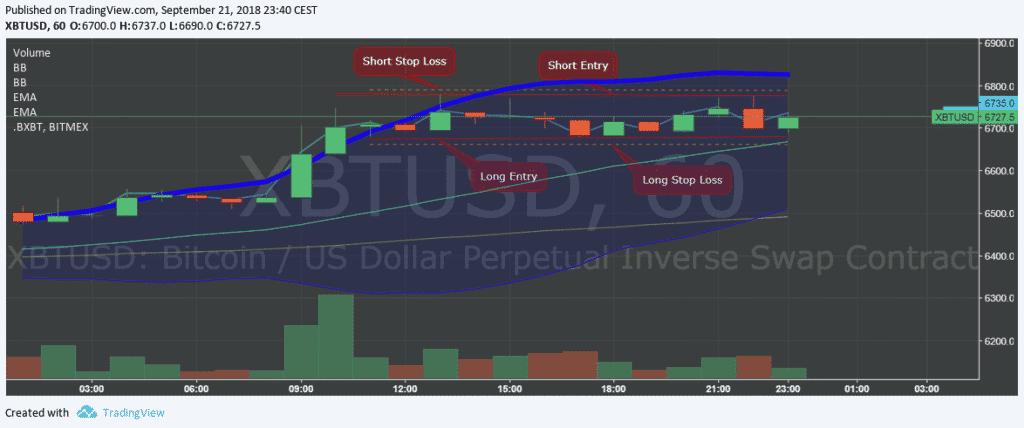
Table of Contents (click to expand)
This is played on the hourly chart, and we want to exploit the tight range of the indecisive sideways movement. 50x to 100x is dangerous!
Things to check before:
- No major news expected (such as an ETF decision).
- The Bollinger Bands are still wide and have no tightening slope.
- The Bollinger Bands should be parallel.
- This should be traded in a volume-based pair, as low liquidity makes it risky.
The process:
- We wait until we have at least four candles that appear as doji, starting to build that tight range we need. Besides, keep it tight with 50x-100x trades.
- We set up limit orders at the red lines: Short entries on the upper red line, with a stop-loss just a few 10-point levels above, shown by the dotted yellow line. Long orders on the lower red line, with a stop loss just a few 10 points below, shown with the dotted yellow line. We use this method only with small amounts, but with huge leverage. Otherwise, the profits would just not be worth it/notable. Both kinds of orders MUST be market orders. This way, we reduce the risk of getting burned and improve our chances of getting filled during spikes.
- The trick is to have both orders of the same size of contracts. This way, we don't need the reduce-only checkbox. So let's say the long trade from the lower red line gets activated; the upper red line (with the same number of contracts) automatically becomes a take-profit order. This is because you will short the same number of long contracts touching it. Example: The lower red line gets touched and fills with 10k contracts. Since we set up the same number of contracts in the opposite direction, a sell order for 10k contracts is already waiting on the upper red line. Once we reach it, jackpot. If you want to make sure you don't get stopped out, you can also set up the sell order in the middle between the prices.
The beauty of this method is that we can play ping pong here. We just set up the orders in both ways, and whatever happens, we can take some nice gains with us. NOTE: Once the Bollinger Bands start to narrow down, a breakout might happen at any time. A more advanced add-on method here would be to make use of a buy stop order (for a short position to actively exploit an upwards breakout – of course, vice versa as well – but this is for the pros). The imminent breakout danger forces us to close all our orders immediately as the bands tighten to further reduce risk.
(Advanced Step/Optional) 4. If you think the breakout will be – for example – upwards, you could take 11k contracts against 10k contracts on the short side. This way, 1k contracts would run further, and you can take more profits with you.
Profit & Risk Calculation – Math time
Case 1: Short order
In this example, a short order might have been filled.
We short 50000 contracts for ~0.085 BTC at 6775 (Leverage 100x)
We take profit at 6680 and gain 0,1050 BTC with an ROE of 142.28%
If it would have gone wrong and we would have been stopped out at 6664:
We would take a loss of 0,0140 BTC with an ROE of -18.79% – Nice risk/reward ratio
Possible gains of 0.1050 BTC against a possible loss of 0.0140 BTC
Case 2: Long order
We buy 50000 contracts for ~0.0861 BTC at 6680 (Leverage 100x) (would not have hit in this example as the first wick was the longest)
We take profit at 6775 and gain 0,1080 BTC with an ROE of 144.29%
If it would have gone wrong and we would have been stopped out at 6670:
We would take a loss of -0,0115 BTC with an ROE of -15.36% – Nice risk/reward ratio
Possible gains of 0.1080 BTC against a possible loss of 0.0115 BTC
Imagine this method plays out very often, as BTC is known for its wick action. More orders became active, but more stops would probably be triggered as well. The only real risk of this method is that a stop order might not be filled, which has never happened to us. However, it has been reported a few times by other users; hence the importance of market orders.
Verified Crypto Traders showing what using good leverage is all about!